
Table of Contents
-
- Introduction
-
- The Shift in “Healthy” Food Marketing
-
- Why Supply Chain is Now the Real Challenge
-
- The Hidden Cost of Being “Healthy”
-
- Where Most Brands Go Wrong
-
- What Smart Brands Are Doing Differently
-
- Strategic Takeaways for Businesses
-
- Conclusion
1. Introduction
Over the last few years, the food industry has seen a massive shift. Earlier, brands could simply label their products as “healthy” and attract customers. But today, things are changing rapidly.
With new global regulations and smarter consumers, “healthy” is no longer just a marketing word — it has become a business responsibility.
This raises an important question:
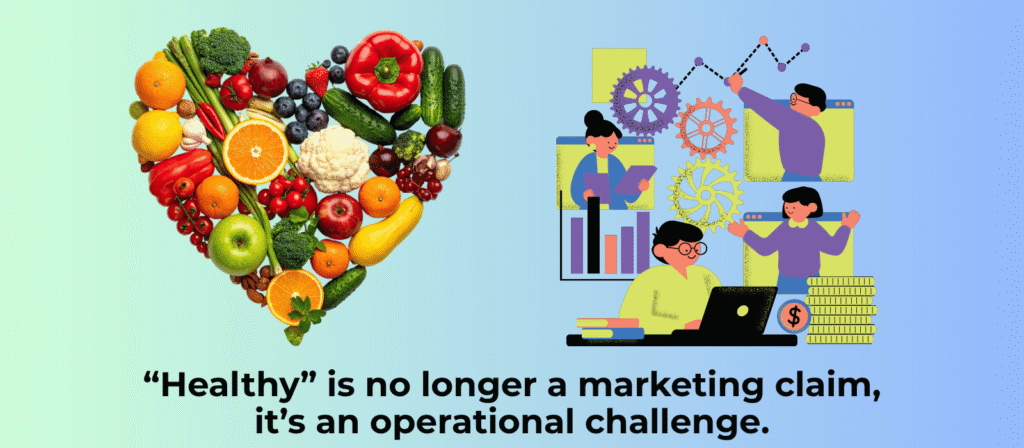
Is healthy food becoming a supply chain problem rather than a marketing one?
2. The Shift in “Healthy” Food Marketing
Traditionally, marketing teams had the power to position a product as healthy through packaging, messaging, and advertising.
But today:
-
- Governments are tightening regulations
-
- Consumers are reading labels carefully
-
- Trust is becoming more important than claims
This means brands can no longer rely only on storytelling.
They must prove it.
This is where the concept of a healthy food supply chain problem starts emerging.
3. Why Supply Chain is Now the Real Challenge
To call a product “healthy,” brands must now:
-
- Reduce sugar, sodium, and unhealthy fats
-
- Use better-quality ingredients
-
- Maintain consistency in sourcing
-
- Ensure compliance with regulations
This is not easy.
A small change in ingredients can affect:
-
- Taste
-
- Cost
-
- Shelf life
For example, many brands that tried switching to natural ingredients faced issues like:
-
- Shorter shelf life
-
- Higher production costs
-
- Inconsistent quality
This clearly shows that healthy food is now a supply chain problem, not just a branding decision.
4. The Hidden Cost of Being “Healthy”
Many founders underestimate what it takes to build a truly healthy product.
Here are the real challenges:
1. Ingredient Sourcing
Healthy ingredients are often:
-
- More expensive
-
- Hard to source consistently
-
- Dependent on seasonal availability
2. Vendor Reliability
If suppliers fail, your product quality drops.
And in the “healthy” category, trust once broken is hard to rebuild.
3. Pricing Pressure
Consumers want healthy products — but at affordable prices.
Balancing cost and quality becomes a major challenge.
This is why many brands struggle — they treat it as a marketing upgrade instead of a supply chain transformation.
4. Where Most Brands Go Wrong
One of the biggest mistakes brands make is:
They change packaging before fixing the product.
They:
-
- Redesign labels
-
- Add “healthy” claims
-
- Invest in ads
But internally:
-
- Ingredients remain the same
-
- Supply chain is weak
-
- Product experience doesn’t match the promise
This leads to a dangerous situation:
Short-term growth, long-term failure.
As we discussed in our previous article on SEO strategies for Pune startups, visibility can bring traffic — but only a strong product can sustain growth.
6. What Smart Brands Are Doing Differently
Smart brands understand that branding starts from the backend.
Instead of rushing to market, they focus on:
1. Product First Approach
They invest in:
-
- R&D
-
- Ingredient quality
-
- Taste optimization
2. Strong Supply Chain Systems
They build:
-
- Reliable vendor networks
-
- Quality control processes
-
- Long-term sourcing strategies
3. Transparent Communication
Once the system is strong, they communicate:
-
- Ingredients clearly
-
- Benefits honestly
-
- No over-promising
These brands don’t just market “healthy” — they build it into their system.
7. Strategic Takeaways for Businesses
If you are building a food brand or working with one, here are key insights:
1. Healthy is Becoming a Baseline
Soon, every brand will claim to be healthy.
So it will no longer be a differentiator.
2. Backend is the New Branding
Your:
-
- Supply chain
-
- Product quality
-
- Ingredient sourcing
…will define your brand more than ads.
3. Marketing Cannot Fix a Weak Product
No matter how strong your campaign is,
if the product fails — the brand fails.
4. Think Long-Term, Not Campaign-Based
Instead of asking:
“How do we market this?”
Start asking:
“Is our product ready to be marketed?”
5. Align Strategy Across Functions
The future belongs to brands that align:
-
- Product
-
- Operations
-
- Marketing
This is exactly where strategic agencies like Black Buck Design Studios bring value — by ensuring clarity before creativity
8. Conclusion
The definition of branding is changing.
It is no longer just about:
-
- Logos
-
- Packaging
-
- Campaigns
It is about:
-
- Systems
-
- Consistency
-
- Trust
So, is healthy food a supply chain problem? Yes — and that’s the opportunity.Brands that invest in strong systems will win.Brands that rely only on marketing will struggle.
In the coming years, the biggest competitive advantage won’t be creativity alone.
It will be the ability to align: Product + Supply Chain + Communication
Because in today’s world: Your backend is your brand.
