
Introduction
Every successful business begins with an idea, but not every idea becomes a successful brand.
Every year, thousands of startups launch with innovative products and ambitious founders. Some quickly gain recognition, attract loyal customers, and establish themselves as industry leaders. Others struggle to differentiate themselves, compete primarily on price, and eventually disappear from the market.
The difference is rarely the product alone.
More often, the difference lies in branding.
A strong brand creates recognition, builds trust, communicates value, and gives customers a reason to choose one business over another. It transforms a product into an experience and a company into a memorable identity.
Many entrepreneurs believe branding starts with designing a logo or choosing brand colors. While visual identity is an important part of branding, it represents only a small portion of the overall process.
True branding begins much earlier. It starts with understanding the business, the customer, the market, and the unique value the company brings. Only then do visual identity, messaging, packaging, website design, and marketing come together to create a consistent brand experience.
Whether you are launching a startup, expanding an SME, or rebranding an existing business, following a structured branding process helps build a foundation for sustainable growth.
At BlackBuck Design Studios, we have worked with businesses across industries including FMCG, healthcare, manufacturing, personal care, SaaS, and retail. One lesson remains consistent across every project: brands that invest in strategy before design build stronger customer relationships and achieve long-term success.
What Is a Brand?
Before understanding how brands are built, it’s important to understand what a brand actually is.
A brand is not just a logo.
It is not your company name.
It is not your packaging alone.
A brand is the complete perception customers have about your business.
Every interaction contributes to your brand.
Your product quality.
Your customer service.
Your website.
Your packaging.
Your advertisements.
Your social media presence.
Your tone of communication.
Even the experience customers have after purchasing your product shapes your brand.
In simple words:
Your brand is what people think, feel, and remember about your business when you are not in the room.
Strong brands intentionally shape these perceptions.
Why Branding Matters for Startups and SMEs
Large corporations often have significant advertising budgets.
Startups and small businesses usually do not.
This makes branding even more important.
When your brand clearly communicates who you are, what you offer, and why customers should trust you, every marketing effort becomes more effective.
Strong branding helps businesses:
- Build credibility.
- Increase customer trust.
- Differentiate from competitors.
- Command premium pricing.
- Improve customer loyalty.
- Generate referrals.
- Attract better employees.
- Simplify marketing communication.
For startups entering competitive markets, branding often becomes one of the most valuable business assets.
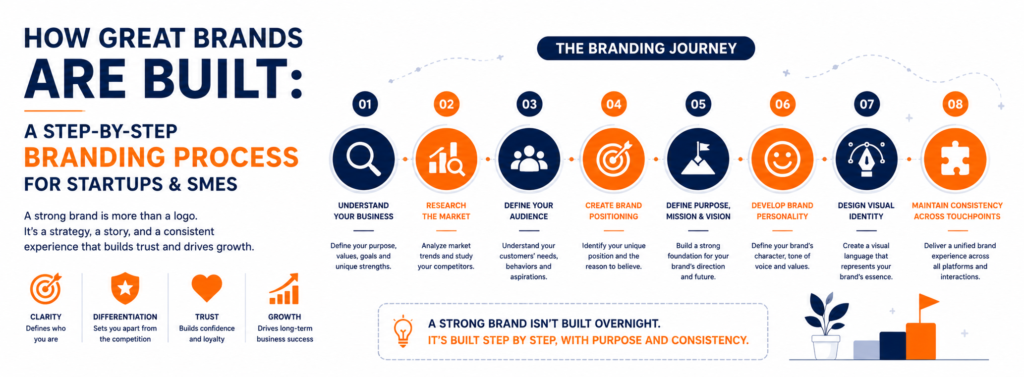
Step 1: Understand Your Business
Every successful branding project begins with understanding the business itself.
Before creating visual identity, businesses should answer fundamental questions.
Why does the company exist?
What problem does it solve?
Who benefits from the solution?
What makes the business different?
What long-term impact does it want to create?
These questions define the foundation of the brand.
Without clear answers, branding becomes superficial.
At BlackBuck Design Studios, every branding project begins with discovery sessions that explore the company’s vision, goals, values, products, and competitive landscape.
Great branding starts with clarity.
Step 2: Research Your Market and Competitors
Branding should never happen in isolation.
Businesses need to understand the environment in which they compete.
Market research reveals:
- Industry trends.
- Customer expectations.
- Competitor positioning.
- Pricing strategies.
- Communication styles.
- Market gaps.
Competitive analysis is equally important.
The goal is not to copy competitors but to identify opportunities for differentiation.
For example, if every skincare brand uses similar colors and messaging, a new brand can stand out by creating a distinct visual identity and a more authentic story.
Differentiation is one of the strongest drivers of brand success.
Step 3: Define Your Target Audience
One of the biggest branding mistakes businesses make is trying to appeal to everyone.
Brands become stronger when they clearly define whom they serve.
Effective audience research includes:
- Age.
- Gender.
- Occupation.
- Income level.
- Lifestyle.
- Buying behavior.
- Motivations.
- Pain points.
- Aspirations.
Understanding customers allows businesses to create messaging, products, and experiences that resonate emotionally.
People don’t buy products simply because they exist.
They buy solutions to problems.
The better a brand understands those problems, the more valuable it becomes.
Step 4: Create Your Brand Positioning
Positioning defines how customers should perceive your business compared to competitors.
It answers a simple but powerful question:
Why should customers choose you instead of someone else?
Strong positioning focuses on differentiation rather than imitation.
For example:
Volvo positions itself around safety.
Apple positions itself around innovation and premium experiences.
Nike positions itself around performance and inspiration.
Your positioning should be clear, believable, and relevant to your target audience.
Without positioning, brands compete primarily on price.
Step 5: Define Your Brand Purpose, Mission and Vision
Customers increasingly support brands that stand for something meaningful.
Purpose explains why your business exists beyond making profits.
Mission explains what your company does today.
Vision describes where the company wants to go in the future.
Together, these elements guide every branding decision.
They also help employees align around a common objective.
Purpose-driven brands often create stronger emotional connections with customers.
Step 6: Develop Your Brand Personality
Imagine your brand as a person.
Would it be professional?
Friendly?
Innovative?
Luxury-focused?
Traditional?
Playful?
Reliable?
Brand personality influences:
- Tone of voice.
- Visual identity.
- Customer interactions.
- Marketing campaigns.
- Social media communication.
Consistency in personality helps customers recognize and remember the brand more easily.
Step 7: Design Your Visual Identity
Only after completing the strategic foundation should businesses begin designing visual assets.
Visual identity includes:
- Logo.
- Color palette.
- Typography.
- Iconography.
- Photography style.
- Illustrations.
- Packaging.
- Business stationery.
- Brand guidelines.
These elements should reflect the strategy developed during the previous stages.
Design should never be based solely on personal preferences.
It should communicate the desired brand perception.
Great design supports strategy.
It does not replace it.
Step 8: Build Consistency Across Every Touchpoint
Customers interact with brands across multiple channels.
Your website.
Social media.
Packaging.
Email communication.
Advertising.
Sales presentations.
Retail stores.
Customer support.
Each touchpoint should reinforce the same identity.
Consistency increases familiarity.
Familiarity builds trust.
Trust influences purchasing decisions.
Strong brands remain recognizable regardless of where customers encounter them.
Why Consistency Builds Strong Brands
Many businesses launch with impressive branding but gradually lose consistency.
Logos change frequently.
Colors vary across platforms.
Messaging becomes inconsistent.
Marketing campaigns adopt different visual styles.
These inconsistencies weaken customer recognition.
Successful brands understand that branding is not a one-time project.
It is an ongoing commitment.
Companies like Apple, Coca-Cola, Starbucks, and Amul have maintained remarkable consistency for decades.
That consistency contributes significantly to their market value.
