

Introduction
Imagine walking into a supermarket looking for a jar of peanut butter, a packet of tea, or a bottle of shampoo. Hundreds of products are placed on the shelves, many offering similar quality, pricing, and benefits. Yet, within a few seconds, you instinctively pick up one particular product.
What influenced your decision?
In most cases, it wasn’t the ingredients, the manufacturing process, or even the price. It was the packaging.
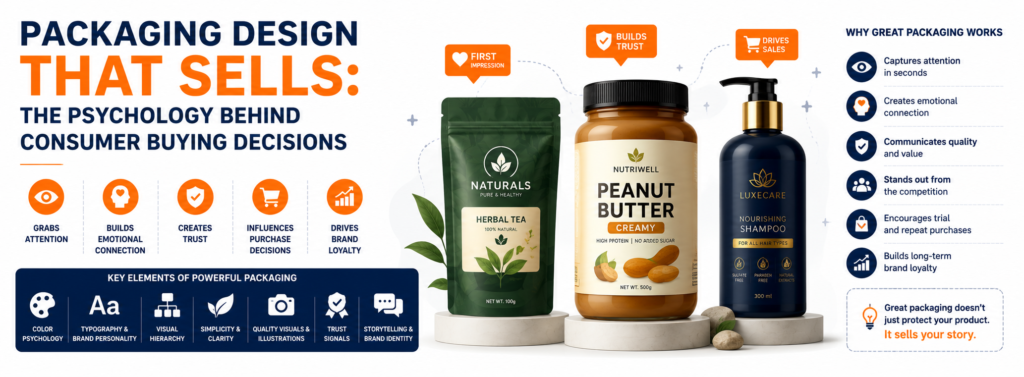
Before customers experience the product, they experience the packaging. It is the first conversation a brand has with its audience. Within just a few seconds, packaging communicates quality, trust, value, personality, and even the emotions associated with the brand.
This is why packaging design is much more than creating an attractive label. It is a powerful marketing tool that directly influences purchasing decisions.
Research consistently shows that consumers often make buying decisions within seconds of noticing a product on a shelf or while browsing online. During this short period, packaging plays one of the most significant roles in attracting attention and building confidence.
For businesses, especially in industries like food, beverages, cosmetics, healthcare, wellness, personal care, and FMCG, packaging can become the difference between being noticed or being ignored.
At BlackBuck Design Studios, we believe great packaging is a combination of strategy, psychology, branding, and creativity. Every design decision—from colors and typography to material selection and product hierarchy—should guide customers toward one outcome: choosing your product over the competition.
Why Packaging Is More Than Just a Container
Many business owners think packaging exists only to protect a product during transportation.
While protection is certainly one of its functions, modern packaging serves many more purposes.
Today’s packaging acts as:
- A silent salesperson.
- A brand ambassador.
- A communication tool.
- A trust-building element.
- A marketing asset.
- A competitive differentiator.
Imagine two products placed side by side.
Both offer similar quality.
Both have similar pricing.
One has professionally designed packaging with clear branding, premium finishes, and an organized information hierarchy.
The other has outdated graphics, inconsistent typography, poor color choices, and cluttered information.
Which product appears more trustworthy?
Most consumers instinctively choose the professionally packaged product because visual quality influences perceived product quality.
In many purchasing decisions, customers don’t evaluate the product first—they evaluate its packaging.
The Psychology Behind Consumer Buying Decisions
Buying decisions are often emotional before they become logical.
Consumers rarely analyze every product in detail.
Instead, their brains process visual information quickly and subconsciously.
Packaging becomes a shortcut that helps people judge:
- Is this product trustworthy?
- Is it premium?
- Is it safe?
- Does it fit my lifestyle?
- Is it worth the price?
Good packaging reduces uncertainty.
Poor packaging increases hesitation.
Understanding consumer psychology helps businesses design packaging that connects emotionally with buyers.
First Impressions Influence Purchase Decisions
Human beings naturally form opinions within moments of seeing something new.
This psychological behavior applies equally to products on retail shelves.
When shoppers walk through supermarkets, pharmacies, or cosmetic stores, they rarely inspect every available option.
Instead, they scan shelves quickly.
Products that stand out visually receive attention first.
Only after grabbing attention do customers begin reading product details.
This means packaging has one primary responsibility:
Earn the customer’s attention before the competition does.
Without attention, even an excellent product remains invisible.
Color Psychology in Packaging Design
Color is often the first element customers notice.
Different colors create different emotional responses.
Understanding color psychology helps brands communicate their positioning more effectively.
For example:
Blue
Blue creates feelings of trust, reliability, and professionalism.
It is commonly used for healthcare, technology, and water products.
Green
Green represents health, nature, freshness, and sustainability.
Organic foods, Ayurvedic products, and eco-friendly brands frequently use green.
Red
Red attracts immediate attention.
It communicates excitement, energy, appetite, and urgency.
Food brands often use red because it stimulates appetite.
Yellow
Yellow conveys optimism, happiness, and warmth.
It is effective for products targeting families and children.
Black
Black represents luxury, sophistication, and exclusivity.
Premium cosmetics, perfumes, and luxury food products often rely on black packaging.
White
White communicates purity, simplicity, and cleanliness.
Healthcare and skincare products frequently use white to create a sense of safety and hygiene.
Successful packaging doesn’t simply use attractive colors.
It uses colors strategically to influence customer perception.
Typography Builds Brand Personality
Typography is another powerful psychological tool.
Customers unconsciously associate different fonts with different brand personalities.
For example:
Elegant serif fonts often communicate tradition, luxury, and craftsmanship.
Modern sans-serif fonts communicate simplicity, innovation, and accessibility.
Bold typography creates confidence.
Minimal typography creates sophistication.
Poor typography, however, reduces credibility.
When product information becomes difficult to read, customers may question the overall quality of the product.
Clear typography improves both trust and usability.
Visual Hierarchy Guides Customer Attention
Customers don’t read packaging like a book.
They scan it.
Great packaging controls the order in which information is consumed.
A strong visual hierarchy ensures customers notice:
- Brand name
- Product name
- Key benefit
- Variant
- Product image
- Quantity
- Certifications
- Supporting information
When hierarchy is poorly designed, customers struggle to understand what the product is or why they should buy it.
Good hierarchy simplifies decision-making.
Simplicity Creates Premium Perception
One of the biggest mistakes businesses make is trying to communicate everything at once.
They fill the packaging with:
- Too many colors.
- Excessive text.
- Multiple claims.
- Numerous icons.
- Complicated graphics.
The result feels cluttered.
Premium brands take the opposite approach.
They communicate fewer messages more effectively.
Minimalism creates clarity.
Clarity builds confidence.
Confidence increases purchase intent.
This is why many luxury brands use generous white space and restrained visual elements.
Product Photography and Illustrations
Visuals significantly influence customer expectations.
Food packaging featuring high-quality photography appears more appetizing.
Cosmetic packaging with elegant illustrations often feels premium.
Healthcare packaging benefits from clean, professional visuals that communicate trust.
Poor-quality images reduce perceived product value.
Custom illustrations and professional product photography create stronger emotional connections than generic stock imagery.
Packaging Must Reflect the Target Audience
Every product serves a different audience.
Packaging should reflect those customers’ expectations.
For example:
Children’s products typically use bright colors, playful illustrations, and rounded typography.
Luxury skincare often features minimal layouts, elegant typography, and premium finishes.
Ayurvedic wellness products frequently combine earthy colors, botanical illustrations, and natural textures to communicate authenticity.
Packaging should never be designed based solely on personal preference.
It should be designed for the people who are most likely to purchase the product.
Trust Signals Influence Buying Decisions
Customers look for signals that reduce perceived risk.
These include:
- Quality certifications
- FSSAI approval
- Organic certifications
- GMP certification
- Made in India
- QR codes
- Customer ratings
- Awards
- Clear manufacturing details
Well-organized trust indicators strengthen credibility without overwhelming the design.
Packaging and Brand Storytelling
Modern consumers buy stories, not just products.
Packaging provides an opportunity to communicate:
- Brand heritage
- Founder story
- Product origin
- Sustainability efforts
- Ethical sourcing
- Craftsmanship
When storytelling is authentic, it creates emotional connections that extend beyond functional product benefits.
Brands like Paper Boat, Forest Essentials, and The Whole Truth have successfully used storytelling through packaging to differentiate themselves in competitive markets.
