
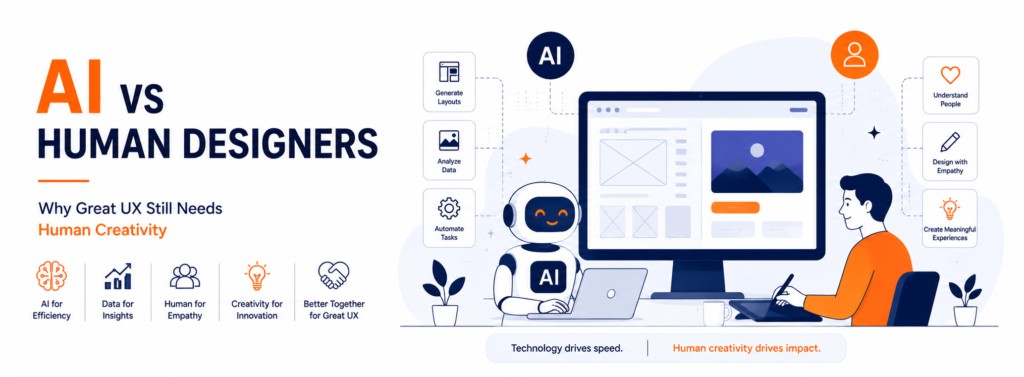
Artificial Intelligence has transformed the design industry faster than anyone imagined. From generating UI layouts and creating wireframes to writing UX copy and producing design systems, AI-powered tools are helping designers work faster and more efficiently than ever before.
As AI continues to evolve, many businesses are asking an important question: Will AI replace human designers?
The answer is more nuanced than a simple yes or no.
In 2026, AI has become an invaluable design assistant, but it has not replaced the creativity, empathy, strategic thinking, and problem-solving abilities that experienced designers bring to the table. Great user experience (UX) is about understanding people—their emotions, motivations, frustrations, and goals. While AI can automate repetitive tasks and analyze vast amounts of data, it still lacks the human intuition required to create truly meaningful digital experiences.
Rather than competing against each other, AI and human designers are becoming powerful collaborators. Businesses that understand how to combine AI efficiency with human creativity are building better products, stronger brands, and more engaging customer experiences.
The Rise of AI in Product Design
Over the past few years, AI has become deeply integrated into modern design workflows.
Today’s AI-powered tools can:
- Generate interface layouts
- Create wireframes
- Suggest color palettes
- Produce icons and illustrations
- Write UX copy
- Generate images
- Analyze user behavior
- Create design variations
- Automate repetitive tasks
These capabilities save time and allow designers to focus on higher-value work.
Instead of replacing creativity, AI is improving productivity.
Why Businesses Are Adopting AI Design Tools
Organizations are embracing AI because it helps accelerate product development.
Benefits include:
- Faster prototyping
- Improved efficiency
- Lower production time
- Better workflow automation
- Rapid content generation
- Data-driven insights
For startups and growing businesses, AI can significantly reduce the time required to launch digital products.
However, speed alone does not guarantee great user experience.
Great UX Begins with Understanding People
User experience is fundamentally about solving human problems.
Before creating interfaces, designers spend time understanding:
- User behavior
- Business objectives
- Customer frustrations
- Emotional triggers
- Accessibility needs
- User journeys
This research shapes every design decision.
Although AI can process user data, it cannot genuinely empathize with users or understand the emotional context behind their actions.
Empathy remains one of the strongest advantages of human designers.
Creativity Cannot Be Fully Automated
AI generates designs by learning from existing patterns.
Human designers create entirely new ideas.
Innovation often comes from:
- Personal experiences
- Cultural understanding
- Creative experimentation
- Strategic thinking
- Emotional storytelling
These qualities are difficult for AI to replicate because they depend on imagination rather than prediction.
Many of the world’s most iconic digital products became successful because designers challenged conventional thinking instead of repeating existing patterns.
UX Is More Than Beautiful Interfaces
Many people associate design with aesthetics.
In reality, UX design focuses on creating products that are:
- Useful
- Intuitive
- Accessible
- Efficient
- Enjoyable
A visually attractive interface can still provide a poor user experience if it fails to solve user problems.
Human designers understand that every interaction should support a larger customer journey.
AI may suggest attractive layouts, but determining whether they truly meet user needs requires human judgment.
Human Designers Understand Context
Every business has unique goals, audiences, and challenges.
A healthcare platform requires different design decisions than an eCommerce website.
A banking application demands different trust signals than a gaming platform.
Human designers evaluate:
- Industry expectations
- Business strategy
- Customer psychology
- Brand personality
- Competitive positioning
AI can generate solutions, but it often lacks the contextual understanding needed to choose the most appropriate one.
Emotional Design Builds Stronger Connections
People rarely remember products simply because they worked well.
They remember experiences that made them feel something.
Human designers intentionally create emotions through:
- Visual storytelling
- Microinteractions
- Typography
- Color psychology
- Motion design
- Brand voice
These emotional details strengthen customer relationships and improve brand loyalty.
While AI can imitate design styles, creating authentic emotional experiences still requires human creativity.
Accessibility Requires Human Thinking
Inclusive design extends beyond technical compliance.
Designers must consider users with:
- Visual impairments
- Hearing impairments
- Limited mobility
- Cognitive disabilities
- Temporary limitations
Creating accessible experiences requires empathy and thoughtful decision-making.
AI can identify accessibility issues, but experienced designers determine how best to solve them while maintaining usability and aesthetics.
AI Makes Designers More Productive
Rather than replacing designers, AI allows them to spend more time on strategic work.
AI can automate:
- Image generation
- Content suggestions
- Component creation
- Design documentation
- Layout exploration
- User data analysis
Meanwhile, designers focus on:
- User research
- Problem-solving
- Product strategy
- Innovation
- Collaboration
- Customer experience
The result is a more efficient design process.
Collaboration Is the Future
The most successful design teams no longer ask whether AI or humans are better.
Instead, they ask:
“How can AI help designers do their best work?”
AI excels at:
- Speed
- Automation
- Pattern recognition
- Large-scale data analysis
- Repetitive tasks
Humans excel at:
- Creativity
- Critical thinking
- Empathy
- Ethics
- Communication
- Strategic decision-making
Together, they create stronger digital products than either could alone.
Common Misconceptions About AI Design
Many businesses misunderstand what AI can actually do.
Common myths include:
Myth: AI will completely replace UX designers.
Reality: AI automates tasks but still requires human direction and validation.
Myth: AI can understand users better than designers.
Reality: AI analyzes behavior but cannot fully understand emotions, motivations, or social context.
Myth: Faster design always means better design.
Reality: Great UX requires research, testing, iteration, and continuous improvement.
Real-World Examples
Many leading technology companies use AI to support—not replace—their design teams.
Companies like Adobe, Figma, Google, and Microsoft are integrating AI into their design tools to automate repetitive work while allowing designers to focus on creativity and innovation.
These organizations recognize that AI improves workflows, but human expertise remains essential for building meaningful experiences.
The Future of UX Design
As AI continues to evolve, the role of designers will also change.
Future UX professionals will spend less time creating repetitive layouts and more time:
- Defining product strategy
- Conducting user research
- Designing AI interactions
- Building ethical experiences
- Creating inclusive products
- Solving complex business challenges
The designer of the future will not compete with AI—they will know how to collaborate with it.
Partnering with Human-Centered Design Experts
Creating exceptional digital products requires more than powerful AI tools. It requires a deep understanding of users, business goals, accessibility, branding, and product strategy. Businesses looking to build meaningful digital experiences often collaborate with experienced design partners who combine modern technology with human creativity. BlackBuck Studios specializes in branding, UI/UX design, website development, and digital product strategy, helping businesses create innovative, user-centered solutions that balance AI capabilities with thoughtful design.
Final Thoughts
Artificial Intelligence is undoubtedly transforming the design industry, making workflows faster, smarter, and more efficient. However, great user experience has never been about technology alone—it has always been about people.
AI can generate layouts, analyze data, and automate repetitive tasks, but it cannot replace empathy, imagination, strategic thinking, or the ability to deeply understand human behavior.
The future of design is not AI versus humans. It is AI and humans working together to create digital experiences that are intelligent, intuitive, and genuinely valuable. Businesses that embrace this balanced approach will be best positioned to build products that not only function well but also earn the trust and loyalty of their users.
