
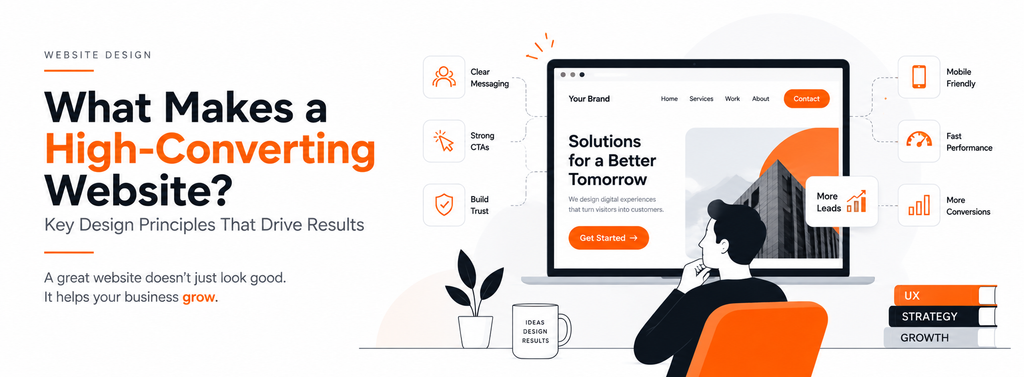
What Makes a High-Converting Website?
A website is more than an online presence. For many businesses, it is one of the most important tools for generating leads, building credibility, and converting visitors into customers.
But simply having a good-looking website doesn’t guarantee results.
A high-converting website is designed around one key objective: making it easy for visitors to understand the business, trust the brand, and take action.
Whether the goal is to generate enquiries, sell products, collect leads, or encourage bookings, effective website design can have a direct impact on business performance.
So, what makes a website convert?
1. A Clear and Powerful First Impression
Visitors form an opinion about a website within seconds.
Your homepage should immediately communicate:
- What your business offers
- Who you serve
- Why customers should choose you
- What visitors should do next
A clear headline combined with a strong supporting message and CTA can help visitors understand your value without having to search through the website.
Instead of complicated messaging, focus on clarity and relevance.
2. Simple and Intuitive Navigation
Good website UX design makes it easy for visitors to find what they need.
If users struggle to locate services, products, contact information, or important content, they are more likely to leave.
Keep navigation:
- Simple
- Consistent
- Easy to scan
- Logically organised
A visitor shouldn’t need to think about how to use your website. The design should naturally guide them from one section to another.
3. Strong Calls-to-Action
A website should clearly tell visitors what they can do next.
This is where effective CTA design becomes important.
Depending on your business, calls-to-action could include:
Get a Quote
Book a Consultation
Start Your Project
Contact Us
Shop Now
Your CTA should be visible, specific, and connected to the visitor’s intent.
Too many competing CTAs can create confusion, while too few can make it difficult for users to take action.
4. Build Trust Through Design
Before contacting a business or making a purchase, users often want to know whether they can trust the brand.
A professional website can build credibility through:
- Client testimonials
- Case studies
- Reviews
- Certifications
- Portfolio work
- Clear contact information
- Professional visual design
Trust isn’t created through one element. It is built through the entire website experience.
5. Reduce User Friction
Every unnecessary step can reduce conversions.
For example, a long enquiry form with too many fields can discourage users from submitting it.
A conversion-focused website should make important actions as easy as possible.
Reduce friction by:
- Keeping forms short
- Simplifying checkout
- Providing clear instructions
- Removing unnecessary pop-ups
- Making contact options easy to find
- Creating clear page structures
The easier the journey, the more likely users are to complete it.
6. Design for Mobile Users
A large percentage of website traffic comes from mobile devices.
A website that looks great on desktop but is difficult to use on a phone can lose potential customers.
Responsive web design ensures that content, buttons, images, forms, and navigation adapt to different screen sizes.
Mobile users should be able to:
- Read content easily
- Navigate comfortably
- Tap buttons without difficulty
- Complete forms
- Contact the business quickly
Mobile-friendly design is no longer optional. It is an essential part of modern website design.
7. Use Visual Hierarchy
Not everything on a webpage should have equal visual importance.
Good visual hierarchy helps users understand where to look first, what information matters, and what action they should take.
Designers can create hierarchy using:
- Typography
- Size
- Spacing
- Contrast
- Images
- Layout
- Position
A well-structured page guides the visitor’s attention instead of making them process everything at once.
8. Speed and Performance Matter
A beautiful website won’t convert effectively if it takes too long to load.
Slow websites can create frustration and increase the chances that users leave before interacting with the page.
Website performance can be improved by:
- Optimising images
- Reducing unnecessary scripts
- Using efficient code
- Limiting heavy animations
- Improving hosting performance
Good website design should consider both visual experience and technical performance.
9. Create Content That Answers User Questions
Design and content should work together.
Visitors often arrive at a website with questions:
What does this business offer?
How much does it cost?
Why should I choose this company?
How does the process work?
Your website content should answer these questions clearly.
Instead of filling pages with generic marketing statements, focus on information that helps visitors make decisions.
10. Design With Business Goals in Mind
The most effective websites aren’t designed only around aesthetics.
Before designing a website, businesses should identify their primary goals.
For example:
Goal: Generate leads
→ Focus on enquiry forms, CTAs, trust signals, and service pages.
Goal: Sell products
→ Focus on product presentation, search, checkout, reviews, and usability.
Goal: Book consultations
→ Focus on scheduling, clear service information, and strong CTAs.
When design decisions are connected to measurable business objectives, the website becomes a business tool rather than simply a digital brochure.
Design for Conversion, Not Just Appearance
A visually impressive website can attract attention, but a high-converting website needs to do more.
It should answer questions, remove doubts, guide visitors, build trust, and make the next step obvious.
The best website design combines:
Visual appeal + UX + clear content + performance + conversion strategy.
When these elements work together, your website can become a powerful source of business growth.
Conclusion
A high-converting website doesn’t happen by accident.
It requires thoughtful planning, user-focused UX design, clear messaging, strong calls-to-action, responsive layouts, fast performance, and a deep understanding of the target audience.
At BlackBuck Design Studio, we believe website design should do more than look professional. It should help businesses attract the right audience, build trust, and turn visitors into meaningful opportunities.
Your website isn’t just where customers find you.
It should be where they decide to choose you.
