
Introduction
Artificial Intelligence (AI) is no longer a futuristic concept—it has become an integral part of how digital products are designed, built, and experienced. Over the past few years, AI has transformed industries ranging from healthcare and finance to education and e-commerce. Today, it is also reshaping one of the most creative fields in technology: UI/UX design.
Designers once relied entirely on manual research, wireframing, prototyping, and user testing to create digital experiences. While these practices remain essential, AI-powered tools are changing the way designers work. From generating interface layouts and writing UX copy to analyzing user behavior and predicting design improvements, AI is helping teams work faster and make more informed decisions.
However, this rapid transformation has sparked an important debate.
Will AI replace UI/UX designers, or will it become their most valuable assistant?
The answer lies somewhere in the middle.
AI is exceptionally good at automating repetitive tasks, identifying patterns in large datasets, and generating design suggestions within seconds. But creativity, empathy, critical thinking, and understanding human emotions remain qualities that only designers can provide.
Rather than replacing designers, AI is changing their role. The future belongs to designers who know how to combine human creativity with artificial intelligence to build experiences that are efficient, meaningful, and user-centered.
At BlackBuck Design Studios, we see AI not as a threat but as a powerful tool that enhances the design process. It enables our team to work more efficiently while ensuring that every design decision is guided by real human needs rather than automation alone.
Understanding AI in UI/UX Design
Artificial Intelligence in UI/UX design refers to the use of machine learning, predictive analytics, natural language processing, and generative AI to improve the design process and enhance user experiences.
Unlike traditional software that follows predefined instructions, AI learns from data and continuously improves its recommendations.
In the context of UI/UX, AI can help designers:
- Generate wireframes and interface concepts.
- Create user personas based on real behavioral data.
- Analyze customer journeys.
- Identify usability issues.
- Personalize digital experiences.
- Predict user preferences.
- Generate UX copy.
- Improve accessibility.
- Automate repetitive design tasks.
Instead of replacing creativity, AI handles repetitive work, allowing designers to focus on solving complex problems and creating memorable user experiences.
Why AI Is Transforming Product Design
Modern digital products generate enormous amounts of user data every day.
Every click, scroll, search, purchase, and interaction provides valuable insights into user behavior.
Traditionally, analyzing this information required weeks of manual research.
Today, AI processes millions of data points within minutes.
For example, AI can identify:
- Where users abandon a checkout process.
- Which buttons receive the most clicks.
- Which layouts improve conversions.
- Which colors attract more attention.
- Which onboarding screens confuse users.
- Which navigation patterns reduce bounce rates.
These insights help designers make evidence-based decisions instead of relying solely on assumptions.
This shift from intuition to data-driven design has become one of AI’s biggest contributions to modern UI/UX.
The Biggest Opportunities AI Brings to UI/UX Design
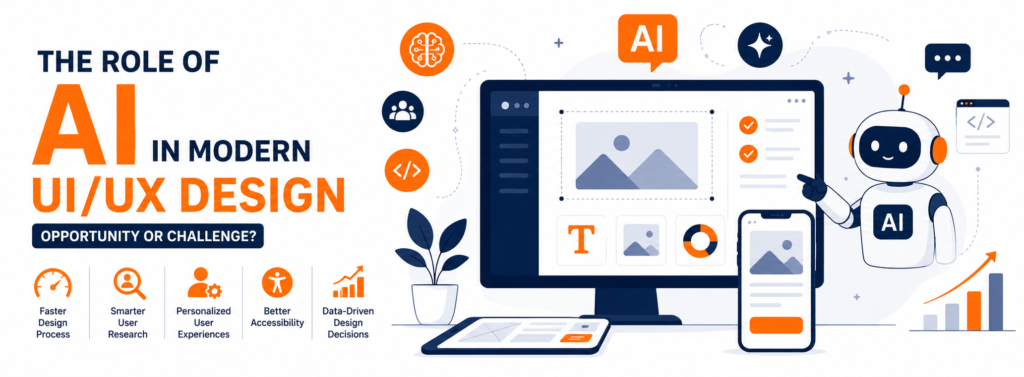
1. Faster Design Process
One of AI’s greatest advantages is speed.
Designers can now generate wireframes, layouts, icons, illustrations, and prototypes within minutes instead of spending hours creating everything manually.
Tools like Figma AI, Adobe Firefly, Uizard, and Galileo AI help teams quickly explore multiple design directions.
Rather than replacing designers, these tools accelerate brainstorming and allow more time for refinement and strategic thinking.
For startups working with tight deadlines, this speed can significantly reduce product development time.
2. Smarter User Research
Understanding users has always been one of the most time-consuming parts of UX design.
AI simplifies this process by analyzing customer behavior at scale.
Instead of manually reviewing thousands of survey responses or usability sessions, AI identifies recurring patterns and pain points automatically.
For example, AI can detect:
- Frequently abandoned screens
- Common navigation mistakes
- Popular user journeys
- Drop-off points
- Customer frustrations
This enables designers to prioritize improvements based on real evidence rather than assumptions.
3. Personalized User Experiences
Today’s users expect products to adapt to their preferences.
AI makes this possible through personalization.
Streaming platforms like Netflix recommend content based on viewing history.
Spotify creates personalized playlists using listening behavior.
Amazon recommends products based on browsing and purchasing patterns.
These experiences are powered by AI and significantly improve user satisfaction.
The same principles apply to websites, mobile applications, and SaaS platforms.
Instead of presenting identical interfaces to everyone, AI enables businesses to create experiences tailored to individual users.
4. Better Accessibility
Accessibility has become a critical aspect of digital product design.
AI is helping designers create experiences that are more inclusive.
Modern AI tools can:
- Suggest better color contrast.
- Detect accessibility issues.
- Generate image descriptions.
- Improve voice interactions.
- Enhance screen reader compatibility.
- Identify usability barriers.
This makes digital products more accessible to users with diverse needs while improving usability for everyone.
5. Improved Design Decisions Through Data
Design has traditionally involved a combination of creativity and intuition.
While intuition remains valuable, AI introduces another important element: data.
Instead of debating which layout might perform better, AI helps teams evaluate user behavior and identify the most effective design solutions.
This reduces guesswork and increases confidence in design decisions.
Companies can continuously optimize their products based on real user interactions rather than personal opinions.
AI Is a Tool—Not a Designer
One of the biggest misconceptions surrounding AI is that it will completely replace UI/UX designers.
The reality is far more balanced.
AI can generate screens.
It can recommend layouts.
It can automate repetitive tasks.
It can analyze data.
But AI cannot truly understand human emotions, business strategy, cultural context, or the subtle psychological factors that influence user behavior.
Great design is about empathy.
It is about understanding people’s frustrations, motivations, fears, and aspirations.
These qualities come from human experience—not algorithms.
That is why the future of UI/UX belongs not to AI alone, but to designers who know how to use AI intelligently.
