

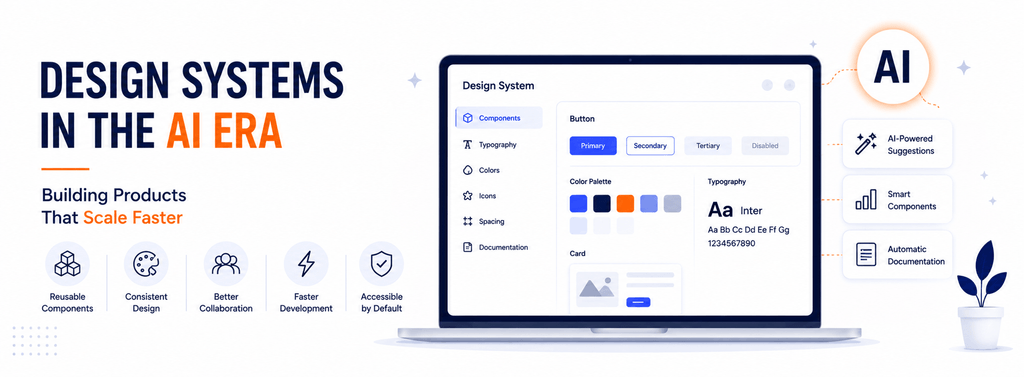
As digital products become more complex and Artificial Intelligence (AI) continues to reshape the way businesses build software, maintaining consistency across websites, mobile apps, and enterprise platforms has become more challenging than ever. Design teams are expected to deliver faster, developers need reusable components, and businesses want products that can scale without sacrificing quality.
This is where design systems have become indispensable.
In 2026, design systems are no longer just collections of UI components or style guides—they have evolved into strategic frameworks that enable organizations to build, maintain, and scale digital products efficiently. Combined with AI-powered design tools, design systems help teams accelerate product development while ensuring a consistent and user-friendly experience across every touchpoint.
For startups and enterprises alike, investing in a robust design system is no longer a luxury; it is a competitive advantage.
What Is a Design System?
A design system is a comprehensive collection of reusable components, design standards, documentation, and guidelines that help teams create consistent digital experiences.
Instead of designing every screen from scratch, designers and developers use predefined building blocks to create interfaces more efficiently.
A modern design system typically includes:
- UI components (buttons, forms, cards, modals, navigation)
- Typography guidelines
- Color palettes
- Icons and illustrations
- Grid systems and spacing rules
- Accessibility standards
- Interaction patterns
- Design tokens
- Development documentation
These elements work together to ensure consistency across products and platforms.
Why Design Systems Matter More in 2026
As businesses expand their digital ecosystems, they often manage multiple websites, mobile applications, customer portals, and internal platforms.
Without a design system, teams frequently encounter:
- Inconsistent user interfaces
- Duplicate design work
- Slower product development
- Communication gaps between designers and developers
- Higher maintenance costs
Design systems solve these challenges by creating a shared language that keeps everyone aligned.
With AI accelerating product development, having standardized design foundations has become even more critical.
How AI Is Transforming Design Systems
Artificial Intelligence is changing the way design systems are created and maintained.
Modern AI-powered design tools can:
- Generate reusable UI components
- Recommend layouts
- Suggest accessible color combinations
- Create documentation
- Identify inconsistencies
- Detect design errors
- Generate design variations
Instead of replacing design systems, AI makes them more intelligent and easier to manage.
Teams can spend less time on repetitive work and more time solving meaningful user problems.
Faster Product Development
One of the biggest advantages of a design system is speed.
Rather than designing every page individually, teams can assemble interfaces using pre-approved components.
This significantly reduces:
- Design time
- Development effort
- QA cycles
- Maintenance costs
AI further accelerates this process by generating layouts and recommending components that align with the design system.
As a result, businesses can launch new products and features much faster.
Consistency Builds Trust
Consistency is one of the foundations of great user experience.
When users encounter familiar buttons, navigation patterns, typography, and interactions across different screens, they feel more confident using the product.
A design system ensures consistency across:
- Websites
- Mobile apps
- Customer portals
- SaaS platforms
- Marketing pages
- Enterprise software
This consistency strengthens brand recognition while improving usability.
Better Collaboration Between Teams
Successful digital products require close collaboration between designers, developers, product managers, and stakeholders.
Without shared standards, communication often becomes inefficient.
Design systems create a common framework that helps every team member understand:
- Component behavior
- Design specifications
- Accessibility requirements
- Interaction patterns
- Implementation guidelines
AI-powered documentation tools make this collaboration even smoother by automatically generating specifications and updating component libraries.
Accessibility Becomes Easier
Accessibility should never be treated as an afterthought.
A well-designed design system includes accessible components from the beginning.
Examples include:
- High-contrast color combinations
- Keyboard-friendly navigation
- Screen-reader compatibility
- Accessible form controls
- Proper typography hierarchy
When accessibility is built into reusable components, every product created with the system benefits automatically.
This reduces development effort while improving inclusivity.
Design Tokens Enable Scalability
Design tokens are reusable values that define visual properties such as:
- Colors
- Typography
- Spacing
- Border radius
- Shadows
- Animations
Instead of manually updating every component, teams modify design tokens, and changes automatically apply across the entire product ecosystem.
This approach simplifies maintenance and enables faster scaling.
AI Improves Component Management
Managing large design systems can become difficult as products grow.
AI can help by:
- Detecting duplicate components
- Identifying inconsistent styles
- Recommending reusable patterns
- Organizing design libraries
- Flagging outdated elements
This keeps design systems clean, organized, and easier to maintain over time.
Supporting Multi-Platform Experiences
Modern businesses rarely build for a single platform.
Customers expect consistent experiences across:
- Websites
- Mobile applications
- Smart devices
- Tablets
- Wearables
- Enterprise software
A design system enables teams to maintain visual and functional consistency regardless of screen size or platform.
AI can further optimize layouts for different devices while preserving the overall design language.
Common Mistakes Businesses Make
Despite the advantages of design systems, many organizations struggle with implementation.
Common mistakes include:
- Treating the design system as a one-time project
- Creating too many unnecessary components
- Failing to document usage guidelines
- Ignoring accessibility
- Allowing inconsistent updates
- Not involving developers early
- Neglecting regular maintenance
A successful design system evolves alongside the product.
It should be treated as a living resource rather than a static document.
Real-World Examples
Some of the world’s leading technology companies have built highly successful design systems.
Google’s Material Design provides comprehensive guidelines that ensure consistency across Android applications and digital products.
IBM Carbon Design System helps enterprise teams build scalable software with reusable components and accessibility built in.
Shopify Polaris enables merchants and developers to create consistent commerce experiences across Shopify’s ecosystem.
These examples demonstrate how design systems improve collaboration, scalability, and product quality.
The Future of Design Systems
As AI becomes increasingly integrated into product development, design systems will evolve beyond component libraries.
Future design systems will likely:
- Generate layouts automatically
- Adapt to user behavior
- Recommend accessibility improvements
- Create documentation in real time
- Predict component usage
- Integrate directly with AI-powered development tools
Rather than simply organizing design assets, they will become intelligent platforms that support faster and more efficient product development.
Building Scalable Digital Products with the Right Design Partner
Creating a successful design system requires expertise in UX strategy, UI design, accessibility, front-end development, and product scalability. Businesses looking to build consistent digital experiences often collaborate with experienced design partners who understand both modern design principles and emerging AI technologies. BlackBuck Studios specializes in branding, UI/UX design, website development, and digital product strategy, helping businesses create scalable design systems that improve collaboration, accelerate development, and deliver exceptional user experiences.
Final Thoughts
As businesses continue to build increasingly sophisticated digital products, consistency and scalability have become essential for long-term success.
Design systems provide the foundation that enables teams to move faster, collaborate more effectively, and deliver cohesive user experiences across every platform. When combined with AI-powered tools, they become even more valuable by reducing repetitive work, improving efficiency, and supporting intelligent product development.
In 2026, the organizations that scale successfully will not be those that design faster—they will be those that design smarter. Investing in a modern design system today is one of the most effective ways to build digital products that remain consistent, adaptable, and ready for the future.
