

Introduction
Imagine visiting two websites for the first time.
The first website has blurry images, inconsistent colors, poor typography, outdated layouts, and confusing navigation. The second website is clean, professionally designed, easy to navigate, and visually appealing. Even before reading a single word, you’ve already formed an opinion about both businesses.
This is the power of visual design.
People don’t just buy products or services—they buy confidence, credibility, and trust. In today’s digital-first world, where customers often interact with a brand online before speaking to a salesperson or visiting a physical store, visual design becomes one of the strongest signals of professionalism and reliability.
Research in consumer psychology consistently shows that people make first impressions within seconds. Those initial impressions are largely influenced by visual elements such as layout, colors, typography, imagery, spacing, and consistency. Once that first impression is formed, it becomes much harder to change.
For businesses, this means that design is no longer just about aesthetics. It directly impacts customer perception, purchasing decisions, conversion rates, and long-term loyalty.
Whether you’re launching a startup, building an e-commerce store, creating a SaaS platform, or redesigning a corporate website, every design decision communicates something about your brand. A polished and consistent design tells customers that your business is professional and trustworthy. A cluttered or outdated design can create doubt, even if your product or service is excellent.
At BlackBuck Design Studios, we believe that great design should do more than look beautiful—it should inspire confidence. Every element, from typography and color palettes to packaging and website layouts, should reinforce trust and encourage customers to take the next step.
Why Trust Is the Foundation of Every Buying Decision
Before customers make a purchase, submit an enquiry, or download an application, they ask themselves one simple question:
“Can I trust this business?”
If the answer is yes, they move forward.
If the answer is no—or even “I’m not sure”—they leave.
Trust isn’t created by a single factor. It’s built through a combination of brand reputation, customer reviews, product quality, communication, and user experience. However, one of the earliest and most influential trust signals is visual design.
When users visit a website, they don’t immediately analyze your technical capabilities or read every page. Instead, they subconsciously evaluate whether your business appears credible.
Professional design communicates:
- Attention to detail
- Stability
- Quality
- Transparency
- Expertise
- Professionalism
Poor design communicates the opposite.
This is why businesses should consider visual design not as an expense but as an investment in customer confidence.
The Psychology Behind Visual Design
Human beings process visual information much faster than text. Long before someone reads your company description, they have already interpreted your brand through visual cues.
This happens because the brain naturally looks for patterns.
When layouts are clean, typography is consistent, and visual hierarchy is well structured, users feel comfortable. They understand where to look, what to do next, and how to navigate the experience.
When design feels disorganized, users experience uncertainty.
That uncertainty often translates into hesitation.
And hesitation reduces conversions.
Good design minimizes uncertainty by making interactions feel familiar and intuitive.
First Impressions Matter More Than Ever
Digital interactions happen incredibly fast.
Within a few seconds, visitors decide whether they want to continue exploring your website or leave.
These early moments are critical because customers often associate visual quality with business quality.
For example, imagine looking for a financial advisor online.
One website appears modern, clean, and professionally designed.
Another uses outdated graphics, inconsistent fonts, broken layouts, and poor-quality images.
Even if both companies offer similar services, most people will naturally trust the first one.
The same principle applies across industries, including healthcare, education, manufacturing, technology, real estate, hospitality, and e-commerce.
Good design immediately communicates credibility.
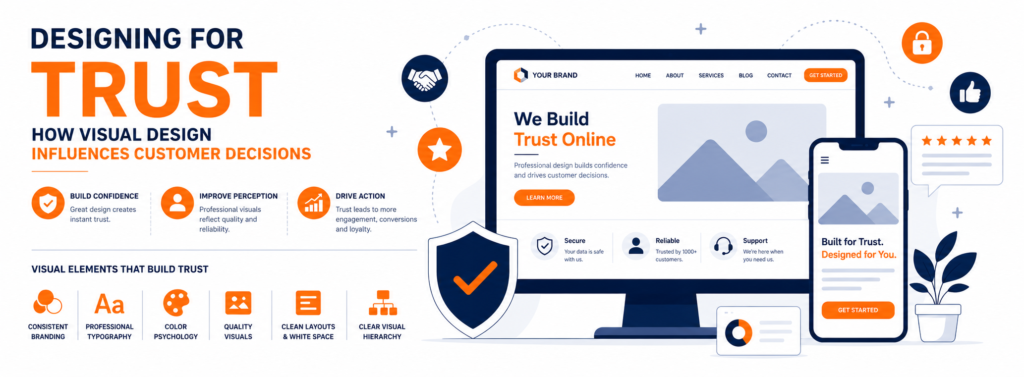
Visual Elements That Build Trust
1. Consistent Branding
Consistency creates familiarity.
When customers see the same colors, typography, logo usage, photography style, and messaging across your website, packaging, social media, and marketing materials, they perceive your business as more reliable.
Imagine if your website used blue branding while your packaging used red, your Instagram followed another style, and your brochures looked completely different.
The inconsistency would create confusion.
Strong brands maintain consistency across every customer touchpoint.
Companies like Apple, Nike, Coca-Cola, and Airbnb have mastered this principle.
Their visual identity remains instantly recognizable wherever customers encounter the brand.
2. Professional Typography
Typography influences readability and perception.
Clear, modern fonts improve comprehension and create a polished appearance.
Poor typography—such as inconsistent font sizes, excessive styles, or difficult-to-read text—creates friction and reduces trust.
Good typography helps users absorb information effortlessly while reinforcing your brand personality.
Luxury brands often use elegant serif fonts to communicate sophistication, while technology companies typically prefer clean sans-serif fonts to emphasize innovation and simplicity.
Choosing typography strategically strengthens brand communication.
3. Color Psychology
Color influences emotions more than many businesses realize.
Different colors create different psychological associations.
For example:
- Blue often communicates trust, security, and professionalism.
- Green represents growth, health, and sustainability.
- Black conveys luxury and authority.
- Orange creates energy and enthusiasm.
- Red attracts attention and communicates urgency.
- White symbolizes simplicity and clarity.
Financial institutions frequently use blue because customers associate it with stability.
Healthcare organizations often use green or blue because these colors evoke calmness and reliability.
Luxury brands rely on black and white to communicate exclusivity.
Selecting colors intentionally helps reinforce the message your brand wants to communicate.
4. High-Quality Photography and Visuals
Customers naturally associate image quality with business quality.
Professional photography communicates authenticity and attention to detail.
Poor-quality stock images, pixelated graphics, or inconsistent visuals reduce credibility.
Whenever possible, businesses should use original photography, custom illustrations, or professionally designed graphics that reflect their actual products, team, or work.
Authenticity builds trust.
5. Clean Layouts and White Space
Many businesses believe adding more information makes their website more valuable.
The opposite is often true.
Overcrowded pages overwhelm users and make important information difficult to find.
White space improves readability, directs attention, and creates a premium appearance.
Minimalism is not about removing content.
It is about organizing content so users can consume it effortlessly.
Brands like Apple have demonstrated how simplicity creates confidence.
6. Clear Visual Hierarchy
Every page should naturally guide users toward the next action.
Visual hierarchy is achieved through:
- Heading sizes
- Font weights
- Color contrast
- Spacing
- Button placement
- Image positioning
Instead of forcing users to search for information, great design presents it in a logical sequence.
This reduces confusion and improves decision-making.
The Connection Between Design and Customer Confidence
Imagine purchasing an expensive product online.
Would you trust a website with broken layouts, inconsistent branding, and unclear product information?
Probably not.
Customers subconsciously evaluate every visual detail before making financial decisions.
Professional design reduces perceived risk.
It reassures customers that the company is established, organized, and capable of delivering on its promises.
This becomes even more important for industries where trust is essential, such as healthcare, finance, education, legal services, and B2B consulting.
