

Imagine walking into a store and seeing dozens of similar products on the same shelf.
You may not know every brand. You may not have researched every product. Yet within a few seconds, one package catches your attention.
Maybe it’s the colour.
Maybe it’s the typography.
Maybe the packaging looks premium, simple, trustworthy, or completely different from everything around it.
That first impression can influence whether you pick up the product, explore it further, or move on to another option.
This is where the psychology of packaging design becomes important.
Packaging isn’t simply a protective layer around a product. It is a powerful branding and marketing tool that communicates what a product represents before a customer even reads the details.
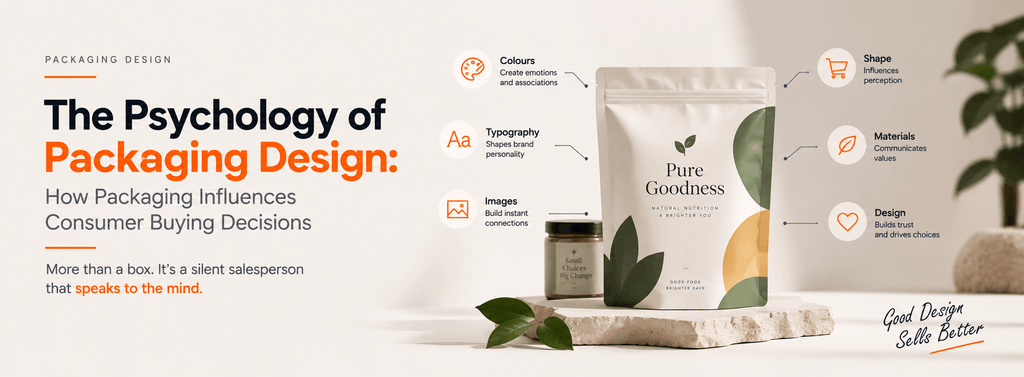
From colours and fonts to shapes, images, materials, and layout, every element can influence how consumers perceive a product and make purchasing decisions.
In this article, we’ll explore how packaging design influences consumer buying behaviour, why visual psychology matters, and how businesses can use strategic packaging design to build stronger brands.
What Is Packaging Design?
Packaging design is the process of creating the visual and functional appearance of a product’s packaging.
It combines elements of:
- Branding
- Graphic design
- Typography
- Colour psychology
- Product positioning
- Consumer behaviour
- Marketing
- User experience
Good packaging needs to do more than look attractive.
It should communicate:
What is the product?
Who is it for?
Why should the customer choose it?
What does the brand stand for?
When these elements work together, packaging can become one of the strongest touchpoints between a brand and its customers.
Why Does Packaging Design Matter?
Consumers are exposed to thousands of marketing messages every day.
In a crowded marketplace, brands have only a limited amount of time to capture attention.
Packaging can help a product stand out before a customer has even interacted with the brand.
Effective packaging can:
- Attract attention
- Communicate product benefits
- Create brand recognition
- Build trust
- Influence perceived quality
- Differentiate a product
- Create emotional connections
- Encourage purchase decisions
- Improve the overall customer experience
For many physical products, packaging is effectively the first salesperson the customer encounters.
The Psychology Behind Packaging Design
Packaging works because consumers don’t make every purchasing decision through detailed logical analysis.
Visual information can create immediate impressions.
A package can make a product appear:
- Premium
- Affordable
- Natural
- Healthy
- Modern
- Traditional
- Luxurious
- Playful
- Professional
- Environmentally conscious
These perceptions can influence how a customer evaluates the product.
This doesn’t mean packaging can guarantee a purchase. Instead, good packaging helps create the right expectations and gives consumers a reason to consider the product.
1. Colour Psychology in Packaging
Colour is one of the most noticeable elements of packaging.
Different colours can create different associations depending on the context, culture, industry, and brand.
For example:
Red can communicate energy, excitement, urgency, or boldness.
Blue is often associated with trust, reliability, calmness, and professionalism.
Green can suggest nature, freshness, sustainability, or health.
Black can create associations with luxury, sophistication, and premium positioning.
Yellow can communicate optimism, warmth, and energy.
However, there is no universal rule that says a particular colour will always produce one specific emotional response.
The combination of colour, typography, imagery, and brand context matters.
For this reason, choosing packaging colours should be a strategic branding decision rather than simply choosing a colour that looks attractive.
2. Typography Can Influence Brand Perception
Typography is another important part of packaging design.
The font used on a package can influence how consumers perceive the brand.
For example, elegant typography may support a luxury positioning, while bold and playful fonts may work better for a youthful or energetic brand.
Typography can communicate:
- Personality
- Tone
- Quality
- Modernity
- Tradition
- Professionalism
But typography also has a practical role.
If the product name, benefits, ingredients, or important information is difficult to read, attractive typography becomes a problem rather than an advantage.
Good packaging design balances personality with readability.
3. Images Create Immediate Associations
Visual imagery can communicate information faster than large amounts of text.
A photograph of fresh ingredients may support a food brand’s natural positioning.
Minimal product photography may communicate simplicity and sophistication.
Illustrations can create a more playful or distinctive identity.
The important thing is consistency.
Images should support the product’s positioning rather than creating expectations that the actual product cannot deliver.
4. Packaging Shape Can Influence Perception
Shape is often overlooked in packaging design.
The physical form of a package can affect how consumers perceive the product.
For example, sleek and minimal packaging may communicate modernity, while traditional shapes can create a sense of heritage.
Unique packaging can also help a product stand out on crowded shelves.
But distinctive packaging should still remain functional.
A package needs to be:
- Easy to hold
- Easy to open
- Practical to store
- Appropriate for transportation
- Suitable for the product
The best packaging combines visual differentiation with usability.
5. Minimalism vs. Visual Complexity
Should packaging contain lots of information or keep things simple?
There isn’t one answer.
The right approach depends on the product, target audience, category, and positioning.
Minimal packaging can communicate:
- Premium quality
- Simplicity
- Modernity
- Confidence
More detailed packaging can communicate:
- Variety
- Information
- Tradition
- Functionality
The key is hierarchy.
Customers should be able to understand the most important information quickly.
A package shouldn’t force consumers to search through multiple visual elements to understand what they’re buying.
6. Packaging Creates Perceived Value
Packaging can influence how valuable a product appears.
Two products may offer similar functionality, but the product with more thoughtful packaging may be perceived as more premium.
Elements that can influence perceived value include:
- Material quality
- Printing quality
- Colour combinations
- Typography
- Finishing techniques
- Structural design
- Visual consistency
This doesn’t mean businesses need expensive packaging.
Strategic design is often more important than excessive decoration.
The packaging should match the product’s price point and positioning.
7. Emotional Connection Can Drive Purchase Decisions
Consumers don’t always purchase products based purely on features.
Emotion plays an important role in brand perception.
Packaging can create feelings such as:
- Nostalgia
- Excitement
- Trust
- Comfort
- Curiosity
- Happiness
- Exclusivity
For example, traditional patterns and familiar visual elements can evoke nostalgia for certain audiences.
A bold, contemporary design may create excitement among consumers looking for something new.
When packaging reflects the emotions associated with a brand, it can make the product more memorable.
8. Consistency Builds Brand Recognition
Imagine seeing the same colour palette, typography, logo style, and visual language across multiple products from the same brand.
Over time, these elements become recognisable.
This is why packaging and branding should work together.
Consistent packaging can help consumers recognise a brand quickly across:
- Retail shelves
- E-commerce websites
- Social media
- Advertisements
- Marketplaces
A strong packaging system allows a brand to introduce new products while maintaining a recognizable identity.
9. Packaging Can Influence Impulse Purchases
Not every purchase is planned.
Sometimes consumers make decisions while browsing a store or scrolling through an online marketplace.
Packaging that quickly communicates:
- What the product is
- What makes it different
- Who it’s for
- Why it’s worth considering
can increase the likelihood that a customer will explore it further.
This is particularly important in competitive categories where multiple products offer similar benefits.
10. Packaging Design in E-Commerce
Packaging isn’t only important on physical retail shelves.
It also matters in e-commerce.
Online shoppers often encounter product packaging through:
- Product photographs
- Marketplace listings
- Social media
- Digital advertisements
- Influencer content
- Unboxing videos
A distinctive package can become part of the brand’s visual identity online.
In addition, the unboxing experience can create another opportunity for brands to build customer loyalty and encourage social sharing.
The Role of Sustainability in Modern Packaging
Consumers are increasingly paying attention to how products are packaged.
Businesses are therefore exploring:
- Recyclable materials
- Reduced packaging
- Reusable packaging
- Sustainable materials
- Minimal printing
- Environment-conscious structures
However, sustainability shouldn’t only be communicated as a marketing claim.
Brands should make sure their packaging choices genuinely support their sustainability message.
Honest and thoughtful packaging can strengthen brand trust.
Common Packaging Design Mistakes
Even attractive packaging can fail if the strategy behind it is weak.
Some common mistakes include:
Too Much Information
Trying to communicate everything at once can make packaging confusing.
Poor Readability
Small text or low contrast can make important information difficult to understand.
Inconsistent Branding
If every product looks completely different, customers may struggle to recognise the brand.
Following Trends Blindly
A design trend may look attractive today but quickly become outdated.
Ignoring the Target Audience
Packaging should be designed around the people who are actually buying the product.
Sacrificing Function for Appearance
Packaging must protect and support the product while delivering a strong visual experience.
How to Create Packaging That Influences Consumers
A successful packaging design process should begin with strategy.
Before designing, businesses should understand:
1. Target Audience
Who is buying the product?
2. Product Positioning
Is the product affordable, premium, natural, innovative, traditional, or something else?
3. Competition
What do competing products look like?
4. Brand Personality
How should customers describe the brand?
5. Buying Environment
Will the product primarily be sold in physical stores, online, or both?
6. Key Message
What is the most important thing customers should understand immediately?
7. Practical Requirements
What materials, dimensions, printing methods, regulations, and transportation requirements need to be considered?
When these questions are answered before the visual design begins, packaging becomes more than decoration.
It becomes a strategic business asset.
Packaging Design Is More Than Just Making a Product Look Good
Great packaging design combines psychology, branding, strategy, functionality, and visual communication.
Every colour, font, image, shape, and material contributes to the story a brand tells.
The goal isn’t to manipulate consumers into buying.
The goal is to make the product’s value clear, create the right expectations, and build a memorable experience around the brand.
In a crowded marketplace, thoughtful packaging can be the difference between a product that gets noticed and one that gets overlooked.
Create Packaging That Makes Your Brand Stand Out
At BlackBuck Design Studios, we believe great design starts with understanding the brand, the audience, and the business goal.
Whether you’re launching a new product, refreshing an existing brand, or looking to create packaging that stands out from competitors, strategic design can help turn packaging into a powerful brand touchpoint.
From branding and packaging design to digital experiences and creative solutions, every visual element should work together to create a clear and memorable brand identity.
Is your product ready for packaging that gets noticed?
Talk to BlackBuck Design Studios and create packaging that doesn’t just protect your product—it helps tell your brand’s story.
Because great packaging doesn’t just sit on the shelf. It makes people stop, look, and remember.
