

Introduction
Ask a business owner, “What is the difference between branding and marketing?” and you’ll often hear answers like, “They’re the same thing,” or “Marketing is just another word for branding.”
This misunderstanding is one of the biggest reasons why many businesses struggle to achieve long-term growth.
Some companies invest heavily in advertising but fail to build a memorable brand. Others spend months designing a logo and brand identity but never create an effective marketing strategy to reach customers. In both cases, businesses miss opportunities because they focus on only one side of the equation.
The truth is simple: branding and marketing are not the same, but they are deeply connected.
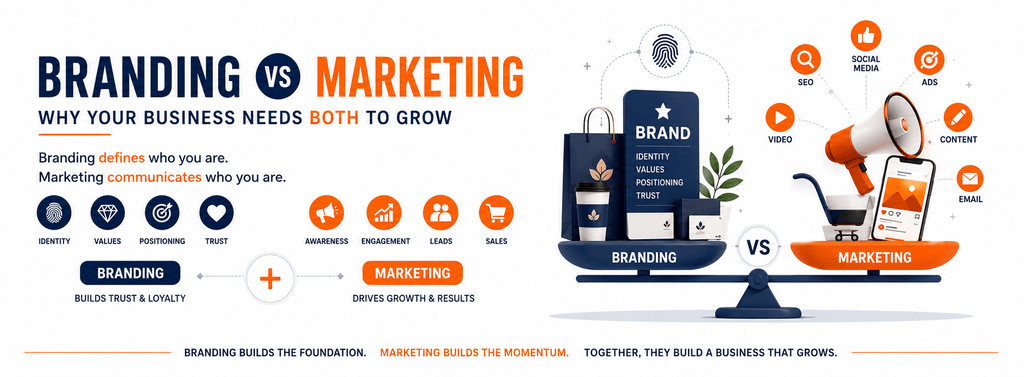
Think of branding as who you are, and marketing as how you communicate who you are.
Branding defines your identity, personality, values, positioning, and the emotional connection people have with your business. Marketing is the collection of strategies and activities that help people discover, understand, and choose your brand.
Without branding, marketing lacks direction.
Without marketing, branding remains invisible.
Businesses that grow consistently understand that success comes from combining both.
At BlackBuck Design Studios, we’ve worked with startups, manufacturers, FMCG brands, healthcare companies, and service businesses. One common pattern stands out: businesses with a strong brand and a clear marketing strategy consistently outperform those that focus on only one.
What Is Branding?
Branding is much more than a logo, color palette, or tagline.
It is the overall perception people have about your business.
Every interaction shapes your brand.
Your website.
Your packaging.
Your customer service.
Your social media.
Your advertisements.
Even the way employees communicate contributes to your brand image.
A strong brand answers important questions:
- Who are you?
- What do you stand for?
- Why should customers trust you?
- What makes you different?
- How do you want customers to feel?
Branding creates emotional connections.
People rarely become loyal because of features alone.
They become loyal because they identify with a brand’s personality, values, and promise.
Think about companies like Apple, Nike, or Amul.
Customers don’t just buy products.
They buy into what these brands represent.
What Is Marketing?
Marketing is the process of attracting potential customers and encouraging them to take action.
Its primary objective is visibility, engagement, lead generation, and sales.
Marketing includes activities such as:
- Search Engine Optimization (SEO)
- Social Media Marketing
- Google Ads
- Facebook and Instagram Advertising
- Content Marketing
- Email Marketing
- Influencer Marketing
- Public Relations
- Video Marketing
- Event Marketing
Marketing introduces your business to new audiences.
It communicates your products, services, and value proposition.
While branding builds perception, marketing drives attention.
The Biggest Difference Between Branding and Marketing
One of the simplest ways to understand the difference is through an analogy.
Imagine your business is a person.
Branding defines that person’s personality.
Marketing introduces that person to the world.
If someone has a great personality but never meets new people, few will know them.
If someone constantly meets new people but behaves inconsistently, trust quickly disappears.
Successful businesses need both.
Branding answers:
- Who are we?
- What do we believe?
- What makes us unique?
Marketing answers:
- How do we reach customers?
- Where should we advertise?
- What message should we communicate?
- Which channels should we use?
Branding creates recognition.
Marketing creates reach.
Together, they create growth.
Why Branding Comes Before Marketing
Many startups make the mistake of launching marketing campaigns before defining their brand.
This creates inconsistent messaging.
For example, imagine a company running Google Ads, Facebook campaigns, influencer collaborations, and SEO.
Every campaign uses different colors.
Different messaging.
Different tone of voice.
Different promises.
Customers become confused.
Consistency disappears.
Marketing may generate traffic, but it fails to build trust.
Before investing heavily in marketing, businesses should establish:
- Brand positioning
- Brand purpose
- Mission and vision
- Target audience
- Brand personality
- Visual identity
- Messaging framework
- Tone of voice
These elements become the foundation for every future marketing activity.
How Branding Influences Customer Decisions
People naturally prefer brands they recognize.
Familiarity creates trust.
Trust reduces risk.
Risk influences purchasing decisions.
Imagine choosing between two skincare products.
Both have similar ingredients.
Both cost approximately the same.
One belongs to a well-established brand with professional packaging, a polished website, consistent messaging, and positive customer reviews.
The other appears inconsistent and unfamiliar.
Most customers choose the trusted brand.
Branding shapes these decisions long before customers compare product specifications.
The Role of Marketing in Business Growth
Once branding establishes a clear identity, marketing amplifies it.
Marketing helps businesses:
- Reach new audiences.
- Generate qualified leads.
- Build awareness.
- Increase website traffic.
- Improve customer engagement.
- Drive sales.
- Retain existing customers.
Different marketing channels serve different objectives.
SEO attracts long-term organic traffic.
Social media builds community.
Google Ads generate immediate visibility.
Email marketing nurtures relationships.
Video marketing improves engagement.
Marketing ensures your brand remains visible in an increasingly competitive marketplace.
Branding Creates Long-Term Value
Marketing campaigns eventually end.
Advertisements stop running.
Promotions expire.
But branding continues influencing customer perception.
Strong brands often spend less on advertising because customers already recognize and trust them.
Think about brands like Apple.
People eagerly wait for product launches before advertisements even begin.
That loyalty results from years of consistent branding.
Businesses that invest in branding create long-term competitive advantages.
Marketing Produces Immediate Results
Unlike branding, marketing focuses on short-term action.
A successful advertising campaign can generate:
- Website visitors.
- Product enquiries.
- Online purchases.
- Appointment bookings.
- Lead generation.
Marketing creates opportunities.
Branding determines whether those opportunities become lasting customer relationships.
Real-World Example
Consider two coffee shops opening in the same neighborhood.
The first invests only in advertising.
It runs Facebook ads and distributes flyers but has no clear identity.
Its logo changes frequently.
Its packaging looks inconsistent.
Its messaging lacks personality.
The second coffee shop spends time developing a memorable brand.
It defines its mission, creates consistent visuals, designs attractive packaging, develops a unique customer experience, and then launches targeted marketing campaigns.
Which business is more likely to build loyal customers?
Most likely, the second.
Marketing may bring customers through the door.
Branding gives them a reason to return.
Common Mistakes Businesses Make
Many businesses unknowingly create problems by misunderstanding branding and marketing.
Some common mistakes include:
- Designing a logo without defining a brand strategy.
- Running advertisements without understanding the target audience.
- Changing brand identity frequently.
- Copying competitors.
- Focusing only on short-term promotions.
- Ignoring customer experience.
- Using inconsistent messaging across platforms.
These mistakes weaken customer trust and reduce marketing effectiveness.
Why Startups Need Both from Day One
Startups often operate with limited budgets.
This makes strategic decision-making even more important.
Rather than viewing branding and marketing as separate investments, startups should treat them as complementary activities.
A clear brand identity improves the effectiveness of every marketing campaign.
Every advertisement, website page, social media post, and product package becomes more persuasive when supported by a consistent brand.
For startups competing against established companies, strong branding often becomes the differentiating factor.
