

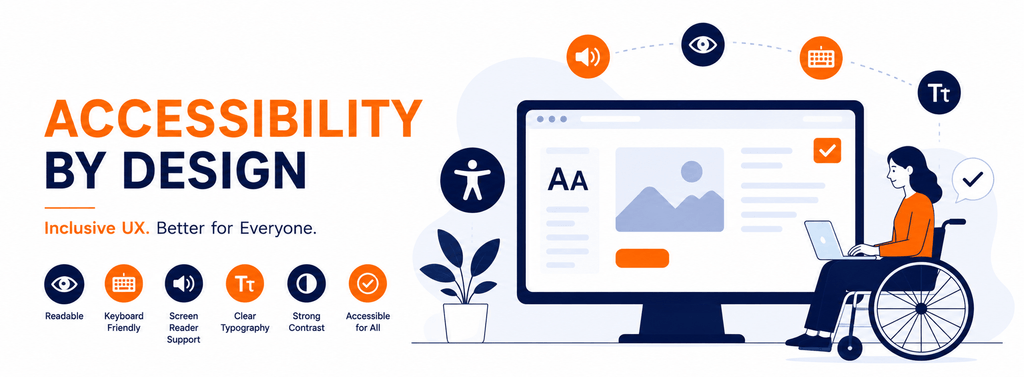
In today’s digital economy, businesses are expected to create experiences that are not only visually appealing but also accessible to everyone. Whether someone is shopping online, booking an appointment, using a banking app, or reading an article, every user should be able to navigate and interact with digital products comfortably.
Yet millions of people still face barriers when using websites and applications because accessibility is often treated as an afterthought rather than a core design principle.
In 2026, that approach is no longer sustainable.
Accessibility is no longer just about complying with guidelines or supporting users with disabilities. It has become a business requirement that improves usability, expands market reach, strengthens brand reputation, and enhances the overall customer experience.
Forward-thinking businesses are embracing Accessibility by Design—an approach where inclusive user experiences are planned from the beginning rather than added at the end of a project.
What Is Accessibility by Design?
Accessibility by Design is the practice of creating digital products that everyone can use, regardless of their physical, cognitive, sensory, or situational abilities.
Instead of fixing accessibility issues after development, designers and developers consider inclusivity throughout the entire product lifecycle—from research and wireframing to design, development, testing, and launch.
Accessible design benefits users who:
- Have visual impairments
- Are deaf or hard of hearing
- Have limited mobility
- Experience cognitive disabilities
- Use assistive technologies
- Browse on older devices
- Access websites in low-bandwidth environments
The goal is simple: create digital experiences that work for as many people as possible.
Why Accessibility Matters More Than Ever
Digital products have become essential to everyday life. People rely on websites and apps for education, healthcare, banking, shopping, government services, and communication.
If these experiences are inaccessible, businesses risk excluding a significant portion of their audience.
Accessibility also influences:
- Customer satisfaction
- Brand trust
- Search engine optimization (SEO)
- User retention
- Conversion rates
- Legal compliance in many regions
Organizations that invest in accessibility demonstrate that they value every customer, regardless of ability.
Accessibility Is Good for Business
Many companies still view accessibility as an additional expense. In reality, it’s a long-term investment that delivers measurable business value.
Accessible digital products often lead to:
- Increased customer reach
- Higher engagement
- Better usability
- Improved SEO performance
- Reduced bounce rates
- Stronger customer loyalty
When websites are easier to use, everyone benefits—not just users with disabilities.
Inclusive UX Improves the Experience for Everyone
Some of the most widely used digital features were originally developed as accessibility improvements.
Examples include:
- Voice assistants
- Closed captions
- Dark mode
- Predictive text
- Keyboard shortcuts
- Voice search
Today, these features are appreciated by millions of users because they improve convenience and usability.
Inclusive design often creates better experiences for every customer.
The Core Principles of Accessible UX
Design with Readability in Mind
Content should be easy to read across all devices.
Businesses should use:
- Clear typography
- Appropriate font sizes
- Comfortable line spacing
- Simple language
- Well-structured headings
Readable content helps users absorb information more efficiently.
Use Strong Color Contrast
Poor color contrast makes content difficult to read, especially for users with low vision or color blindness.
Good contrast improves:
- Readability
- Navigation
- Visual clarity
- User confidence
Accessible color choices also enhance the overall appearance of a website.
Make Navigation Simple
Visitors should never struggle to find information.
Accessible navigation includes:
- Clear menus
- Logical page structure
- Breadcrumb navigation
- Keyboard-friendly controls
- Consistent layouts
The easier it is to navigate a website, the more likely users are to complete their goals.
Design for Keyboard Users
Not every visitor uses a mouse or touchscreen.
Many people rely entirely on keyboards or assistive technologies to browse websites.
Businesses should ensure users can:
- Navigate menus
- Complete forms
- Access buttons
- Open dialogs
- Submit information
All without requiring a mouse.
Add Alternative Text to Images
Images should include descriptive alternative text (alt text) so screen readers can communicate visual information to users with visual impairments.
Effective alt text should describe the purpose of an image rather than simply stating what it contains.
This also contributes to better SEO.
Create Accessible Forms
Forms are one of the most common sources of accessibility problems.
Accessible forms should include:
- Clear labels
- Helpful error messages
- Logical field order
- Keyboard support
- Visible focus indicators
Simple forms reduce frustration and improve completion rates.
Mobile Accessibility Matters Too
With mobile devices accounting for the majority of internet traffic, accessibility must extend beyond desktop experiences.
Mobile-first accessibility includes:
- Large touch targets
- Readable text
- Responsive layouts
- Voice navigation support
- Clear buttons
- Simple gestures
Designing for mobile accessibility improves usability across every device.
Accessibility Supports Better SEO
Search engines reward websites that provide structured, user-friendly experiences.
Many accessibility best practices also improve search engine optimization, including:
- Proper heading hierarchy
- Alternative image text
- Descriptive links
- Clean HTML structure
- Faster loading pages
- Mobile optimization
Creating accessible websites often leads to stronger organic visibility.
Common Accessibility Mistakes Businesses Make
Despite growing awareness, many organizations continue to make avoidable mistakes.
These include:
- Low color contrast
- Missing image descriptions
- Tiny clickable elements
- Auto-playing media
- Poor keyboard navigation
- Unlabeled form fields
- Complex layouts
- Inconsistent navigation
Identifying and correcting these issues can dramatically improve user experience.
Accessibility Builds Brand Trust
People remember businesses that make them feel included.
An accessible website communicates:
- Professionalism
- Empathy
- Attention to detail
- Customer-first thinking
Brands that prioritize inclusivity often enjoy stronger customer loyalty because they remove barriers instead of creating them.
Accessibility isn’t just a technical improvement—it reflects a company’s values.
Preparing for the Future of Digital Experiences
As technology continues to evolve, accessibility will become even more important.
Artificial intelligence, voice interfaces, wearable devices, and immersive digital experiences must all be designed with inclusivity in mind.
Organizations that embed accessibility into their design process today will be better prepared for tomorrow’s digital landscape.
Rather than viewing accessibility as a checklist, businesses should see it as an ongoing commitment to delivering exceptional experiences for every user.
Partner with Accessibility-Focused Design Experts
Building accessible digital products requires more than following technical guidelines. It involves understanding user behavior, inclusive design principles, usability testing, and modern development practices. Businesses looking to create accessible, user-friendly websites and digital products often collaborate with experienced design partners. BlackBuck Studios specializes in branding, UI/UX design, website development, and digital marketing, helping businesses build inclusive digital experiences that are visually engaging, high-performing, and accessible to a broader audience.
Final Thoughts
Accessibility is no longer a feature reserved for compliance—it has become an essential part of modern user experience design.
Businesses that prioritize inclusive UX create products that are easier to use, reach a wider audience, improve customer satisfaction, and strengthen their brand reputation. More importantly, they demonstrate that every customer matters.
As digital experiences continue to shape how people interact with businesses, designing for accessibility from the very beginning is one of the smartest investments an organization can make. In 2026 and beyond, inclusive design isn’t simply the right thing to do—it’s a strategic business advantage.
