

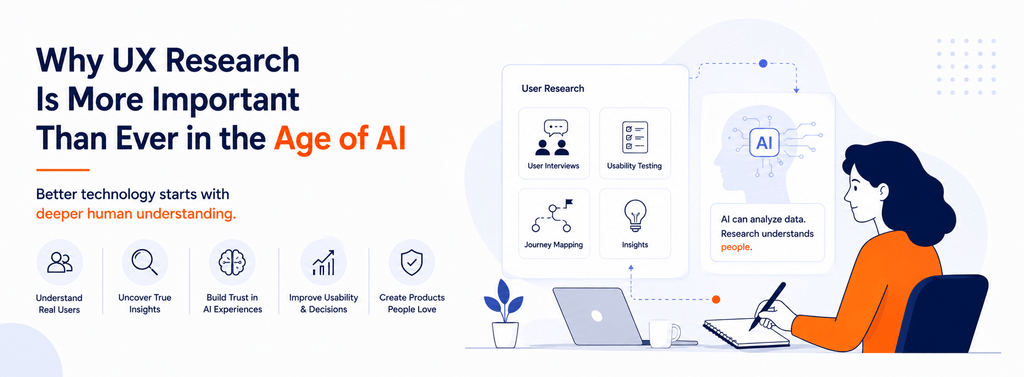
Artificial Intelligence (AI) is transforming the way digital products are designed, developed, and experienced. From AI-powered chatbots and recommendation engines to predictive analytics and intelligent assistants, businesses are integrating AI into almost every aspect of their products. While these innovations have made digital experiences faster and more personalized, they have also introduced new challenges for designers and product teams.
One misconception many organizations have is that AI can replace the need for understanding users. In reality, the opposite is true.
As AI becomes more capable, UX research has become more important than ever. Successful AI-powered products are not built solely on algorithms—they are built on a deep understanding of human behavior, expectations, emotions, and decision-making.
In 2026, businesses that invest in user research are creating products that are not only intelligent but also trustworthy, intuitive, and genuinely valuable. Without UX research, even the most advanced AI technology can fail to deliver meaningful customer experiences.
What Is UX Research?
UX (User Experience) research is the process of understanding users, their goals, behaviors, needs, motivations, and challenges before designing a product or feature.
Instead of making assumptions, UX researchers collect real insights through methods such as:
- User interviews
- Surveys
- Usability testing
- Contextual inquiries
- Analytics reviews
- Heatmaps
- A/B testing
- Journey mapping
These insights help businesses make informed design decisions that improve usability and customer satisfaction.
Why AI Doesn’t Replace UX Research
AI can analyze massive amounts of data within seconds, identify patterns, and generate recommendations. However, it cannot fully understand why people behave the way they do.
For example, AI may identify that users abandon a checkout page, but it cannot always explain whether the reason is:
- Lack of trust
- Confusing navigation
- Unexpected costs
- Poor mobile usability
- Emotional hesitation
UX research uncovers the human context behind the data, enabling businesses to solve the right problems instead of simply reacting to metrics.
Understanding Human Behavior Is More Important Than Ever
AI-powered products often make decisions on behalf of users, recommend actions, or automate workflows.
This means designers must understand:
- How much control users want
- When users trust AI recommendations
- What information users need before making decisions
- How people react when AI makes mistakes
These insights cannot be discovered through algorithms alone.
They require direct interaction with real users.
AI Changes User Expectations
The rapid growth of AI has significantly changed customer expectations.
Users now expect products to be:
- Personalized
- Context-aware
- Fast
- Predictive
- Easy to use
Meeting these expectations requires continuous user research.
Businesses must regularly validate whether AI-powered features actually improve the user experience rather than simply adding technical complexity.
UX Research Helps Build Trust in AI
Trust has become one of the biggest challenges in AI-powered product design.
Users often ask:
- Why did the AI recommend this?
- Can I trust this decision?
- What data is being used?
- Can I change the result?
UX research helps answer these questions by revealing what users need to feel confident when interacting with AI systems.
Research findings often influence:
- Transparency
- Explainability
- User control
- Privacy settings
- Error handling
These elements directly affect customer trust.
Data Alone Doesn’t Tell the Whole Story
Analytics dashboards provide valuable information about what users are doing.
UX research explains why they’re doing it.
For example:
Analytics may show that users spend only 20 seconds on a page.
Research may reveal that:
- The content is difficult to understand.
- Navigation is confusing.
- The interface feels overwhelming.
- Important information is missing.
Without research, businesses risk making incorrect assumptions about customer behavior.
UX Research Reduces Costly Mistakes
Launching AI features without validating user needs can be expensive.
Businesses often waste time and resources building features that customers never use.
UX research minimizes this risk by helping teams:
- Validate ideas early
- Prioritize valuable features
- Improve usability
- Identify friction points
- Reduce redesign costs
The earlier problems are identified, the easier and less expensive they are to fix.
Research Supports Better Personalization
Personalization has become a defining feature of AI-powered products.
However, meaningful personalization requires understanding what users actually value.
Research helps businesses discover:
- Customer goals
- Behavioral patterns
- Content preferences
- Purchase motivations
- Pain points
These insights enable AI systems to deliver recommendations that feel relevant rather than intrusive.
Human-Centered AI Starts with Research
The best AI products are designed around human needs—not technical capabilities.
UX research helps teams answer important questions such as:
- Does this AI feature solve a real problem?
- Will users understand how it works?
- Does it reduce effort?
- Does it improve decision-making?
- Is it easy to trust?
These questions shape AI experiences that genuinely improve users’ lives.
Common UX Research Methods in the AI Era
Modern product teams use a combination of qualitative and quantitative research methods.
Popular approaches include:
User Interviews
Gain deep insights into user motivations, frustrations, and expectations.
Usability Testing
Observe how people interact with AI-powered interfaces and identify usability issues.
A/B Testing
Compare different AI experiences to determine which performs better.
Behavioral Analytics
Analyze how users navigate products and interact with AI-generated recommendations.
Journey Mapping
Understand how AI fits into the broader customer experience.
Combining multiple research methods provides a more complete understanding of user needs.
Common Mistakes Businesses Make
Many organizations unintentionally reduce product quality by skipping research.
Common mistakes include:
- Assuming AI knows what users want
- Designing around technology instead of people
- Testing products too late
- Ignoring qualitative feedback
- Overlooking accessibility
- Measuring success using only analytics
Successful AI products balance technological innovation with continuous user validation.
Real-World Examples
Leading technology companies invest heavily in UX research despite having access to advanced AI technologies.
Companies like Google, Microsoft, Adobe, and Spotify continuously test new features with users before releasing them widely.
Their success demonstrates an important principle:
Better technology alone doesn’t create better user experiences.
Understanding people does.
The Future of UX Research
As AI continues to evolve, UX research will expand into new areas, including:
- Human-AI collaboration
- Trust and explainability
- Ethical AI experiences
- Voice interfaces
- Multimodal interactions
- Personalized user journeys
Researchers will play an increasingly important role in ensuring AI remains useful, transparent, and human-centered.
Building AI Products Around Real User Needs
Developing successful AI-powered products requires more than advanced technology—it requires a deep understanding of the people who will use them. Businesses looking to create intelligent digital experiences often partner with experienced UX professionals who combine research, strategy, design, and technology. BlackBuck Studios specializes in UX research, UI/UX design, branding, website development, and digital product strategy, helping businesses build AI-ready products that are intuitive, accessible, and centered around real user needs.
Final Thoughts
Artificial Intelligence is changing how digital products are built, but it has not changed the fundamental purpose of design: solving human problems.
As AI becomes more powerful, understanding user behavior becomes even more critical. UX research provides the insights needed to design products that people trust, enjoy, and find genuinely useful.
Businesses that combine AI innovation with continuous user research will create products that stand out not because they use the latest technology, but because they deliver meaningful experiences.
In 2026 and beyond, the most successful AI-powered products won’t simply be the smartest—they’ll be the ones designed with people at the center.
