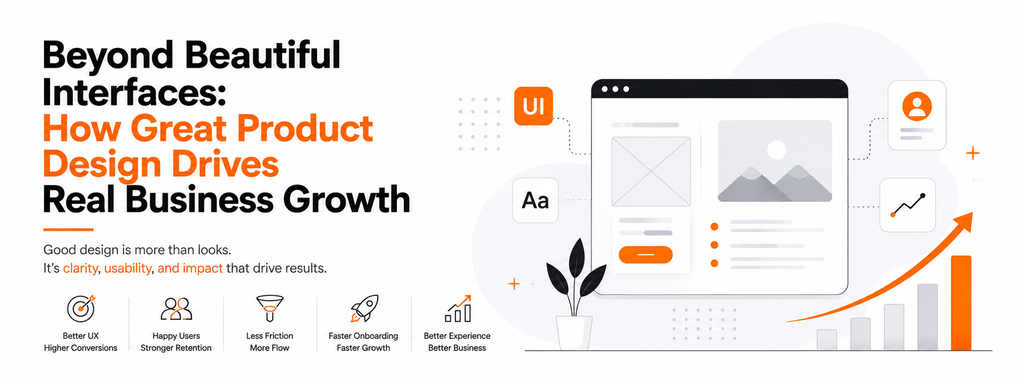
A beautiful interface can grab attention, but great product design goes much further than aesthetics.
In today’s competitive digital landscape, businesses are no longer competing only on price or features. They are competing on the quality of the experience they provide.
A customer may discover your product because of its features, but they often decide whether to stay because of how easy, useful, and enjoyable it is to use.
This is where strategic product design becomes a business advantage.
Good product design connects what users need with what a business wants to achieve. It can reduce friction, improve conversions, increase customer satisfaction, encourage retention, and ultimately contribute to revenue growth.
So, product design isn’t simply about making an app or website look attractive.
It’s about designing experiences that solve problems and create measurable business value.
What Is Product Design?
Product design is the process of researching user needs, identifying problems, creating solutions, testing ideas, and continuously improving a digital or physical product.
In digital products, it can include:
- User research
- UX strategy
- Information architecture
- Wireframing
- UI design
- Prototyping
- Usability testing
- Design systems
- Interaction design
- Product optimization
Unlike visual design alone, product design considers the entire user journey.
A designer isn’t only asking:
“Does this screen look good?”
They’re also asking:
- Can users understand it?
- Can they complete their task easily?
- Where might they get confused?
- What prevents them from converting?
- What can make the experience faster?
- Does the experience support the business objective?
That broader perspective is what makes product design valuable to businesses.
Beautiful Design vs. Effective Design
A visually impressive product isn’t necessarily a successful product.
You can have:
Beautiful UI + Poor usability = Frustrated users
On the other hand:
Good UX + Clear business strategy = Better product outcomes
Visual design still matters. Colors, typography, spacing, imagery, animation, and branding influence perception.
But aesthetics should support usability rather than compete with it.
For example, a visually sophisticated checkout page may look impressive, but if users struggle to find the payment button, the design isn’t doing its job.
The best digital products balance:
Visual appeal + usability + business goals + user needs
How Product Design Contributes to Business Growth
1. Better UX Can Increase Conversions
Every digital product has important conversion points.
For an e-commerce business, it could be:
Product discovery → Product page → Cart → Checkout → Purchase
For a SaaS company:
Website → Sign-up → Onboarding → Product usage → Subscription
At every stage, friction can cause users to leave.
Strategic UX design identifies these friction points and simplifies the journey.
For example, improving:
- Form design
- Navigation
- CTA placement
- Checkout flow
- Information hierarchy
- Error messages
- Mobile usability
can make it easier for users to complete important actions.
The objective isn’t to manipulate users into converting.
It’s to remove unnecessary obstacles that prevent users from doing what they already want to do.
2. Good Design Improves Customer Retention
Getting a customer is only the beginning.
Businesses also need customers to return.
A confusing product can lead to frustration, support requests, negative reviews, and eventually churn.
Good product design creates experiences that feel:
- Simple
- Predictable
- Helpful
- Efficient
- Consistent
When customers can accomplish their goals without unnecessary effort, they have more reasons to continue using the product.
This is particularly important for:
- SaaS products
- Fintech platforms
- E-commerce
- Healthcare applications
- Subscription businesses
- Mobile apps
In these industries, retention can be just as important as acquisition.
3. Product Design Reduces User Friction
User friction is anything that makes an experience unnecessarily difficult.
Examples include:
- Too many form fields
- Confusing navigation
- Slow or unclear onboarding
- Poor error messages
- Unclear pricing
- Complicated checkout
- Inconsistent interface patterns
Each individual problem might seem small.
But collectively, they can significantly affect the user experience.
Imagine a user needs five steps to complete something that could reasonably take two.
That extra effort creates friction.
A strong UX strategy looks for opportunities to eliminate unnecessary steps while keeping the experience clear and secure.
4. Better Onboarding Gets Users to Value Faster
First impressions matter.
When someone signs up for a new digital product, they need to understand:
What is this?
Why should I care?
What should I do next?
Poor onboarding can cause users to abandon a product before experiencing its value.
Effective onboarding can:
- Explain the product clearly
- Guide users toward important actions
- Reduce cognitive overload
- Personalize the experience
- Demonstrate value quickly
The goal is to reduce the time to value.
The faster users understand why a product is useful, the more likely they are to continue exploring it.
5. Design Builds Brand Trust
Users make judgments quickly.
Before reading every feature or understanding your technology, they experience your brand through its interface.
An inconsistent or outdated interface can create doubts:
Is this company reliable?
Is my information safe?
Will this product work properly?
Consistent visual and interaction design can communicate professionalism and reliability.
Trust can be influenced by details such as:
- Clear content
- Consistent branding
- Professional visual hierarchy
- Transparent pricing
- Helpful error messages
- Secure payment experiences
- Accessible interfaces
This is why UX and brand perception are closely connected.
6. Good Design Can Reduce Business Costs
Product design doesn’t only create revenue opportunities.
It can also reduce costs.
Consider a product with confusing navigation.
Users may repeatedly contact customer support because they cannot find basic functionality.
If UX improvements make those functions easier to discover, the business may receive fewer repetitive support requests.
Similarly, usability testing before development can identify problems before they become expensive engineering changes.
This creates an important principle:
Finding a problem early is usually cheaper than fixing it after launch.
7. Design Improves Collaboration Between Teams
Product design can also improve internal efficiency.
A strong design process creates alignment between:
- Product managers
- Designers
- Developers
- Marketing teams
- Sales teams
- Business stakeholders
Instead of each team interpreting the product differently, everyone works toward a shared user and business objective.
Design systems can further improve efficiency by providing reusable components and clear standards.
This reduces duplicated work and creates greater consistency across the product.
8. Data Makes Product Design More Business-Focused
Modern product design shouldn’t rely entirely on assumptions.
Businesses have access to valuable behavioral data through:
- Analytics
- Heatmaps
- Session recordings
- Conversion data
- Customer feedback
- Usability testing
- A/B testing
This information can help designers understand where users struggle.
For example, if analytics show that many users abandon a process on the same step, the design team can investigate why.
Perhaps the form is too long.
Perhaps the information isn’t clear.
Perhaps users don’t understand what happens next.
Data doesn’t replace design thinking.
Instead, data and research help designers make better decisions.
Measuring the ROI of UX Design
One common question businesses ask is:
“How do we know whether our design investment is working?”
UX performance can be connected to measurable business metrics.
Depending on the product, these can include:
Conversion Rate
How many users complete a desired action?
Retention Rate
How many users continue using the product?
Churn Rate
How many customers stop using the service?
Task Completion Rate
Can users successfully complete important tasks?
Time on Task
How long does it take users to complete an activity?
Customer Satisfaction
How do users perceive the experience?
Support Requests
Are customers asking fewer questions after UX improvements?
The exact metrics depend on the business model.
The key is connecting design decisions with real outcomes.
Product Design Should Start With the Problem
One of the biggest mistakes businesses make is starting with the interface.
They say:
“We need a new website.”
or:
“We need a new app design.”
But the better starting point is:
“What problem are we trying to solve?”
A strong product design process typically begins with:
Research → Define → Ideate → Prototype → Test → Launch → Measure → Improve
This approach allows teams to understand the problem before investing heavily in the solution.
Why Businesses Need Strategic Product Designers
The role of a product designer has evolved.
Designers are no longer responsible only for screens and visual elements.
Modern product designers increasingly contribute to:
- Product strategy
- Customer research
- Business goals
- User journeys
- Design systems
- Experimentation
- Product metrics
- Cross-functional collaboration
This makes design a strategic function rather than simply a visual service.
For businesses, the question shouldn’t be:
“How much does design cost?”
It should be:
“What business problem can better design help us solve?”
The Future of Product Design
As AI, automation, personalization, and new interaction models continue to evolve, product design will become even more important.
Digital products are becoming more intelligent, but increased technological capability also creates increased complexity.
Designers have to make that complexity understandable.
The future isn’t simply about creating more attractive interfaces.
It’s about creating products that are:
- Useful
- Accessible
- Intelligent
- Trustworthy
- Easy to understand
- Efficient
- Human-centered
Businesses that treat design as a strategic investment will be better positioned to adapt to changing customer expectations.
Conclusion
Great product design isn’t decoration. It’s a business strategy.
A well-designed digital product can make it easier for customers to discover value, complete tasks, trust a brand, and continue using a product.
For businesses, that can translate into better conversion, stronger retention, lower support costs, and more sustainable growth.
The most successful products don’t simply look beautiful.
They make people’s lives easier while helping businesses achieve their goals.
At BlackBuck Design Studio, we believe great design sits at the intersection of user needs, technology, and business strategy.
Because when design solves the right problems, its impact goes far beyond the interface.
