
Artificial intelligence is changing how people interact with digital products. Instead of manually completing every step, users can now tell an AI system what they want and allow it to perform tasks on their behalf.
These systems, commonly known as AI agents, can understand goals, make decisions, perform actions, and adapt based on context.
But as AI becomes more capable, one important question becomes increasingly important:
Can users trust AI while still remaining in control?
This is where thoughtful AI UX design becomes essential.
What Are AI Agents?
An AI agent is a system that can take action to achieve a user’s goal rather than simply providing information.
For example, instead of searching for flights, comparing options, and booking manually, a user could tell an AI agent:
“Find a suitable flight for me within my budget.”
The AI could search, compare options, and recommend a choice.
This creates a different type of digital experience where the user and AI work together.
Why Trust Matters in AI UX
Traditional software usually performs actions only when users click or select something.
AI agents can make decisions and complete multiple steps automatically. This makes trust a critical part of agentic UX.
Users should be able to understand:
- What the AI is doing
- Why it is doing it
- What information it is using
- What actions it can take
- When human approval is required
A transparent experience helps users feel confident instead of feeling that the AI is operating like a black box.
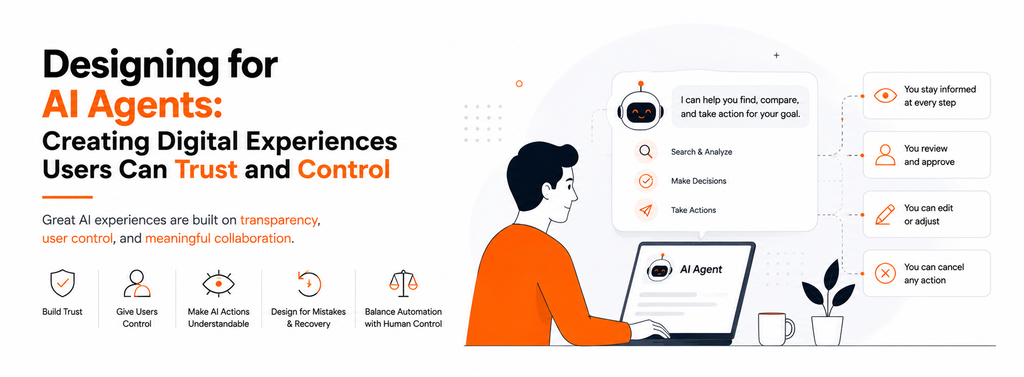
Give Users Control
One of the most important principles when designing for AI agents is maintaining user control.
Not every action should happen automatically.
For example, an AI might automatically organize information or create a draft. But sending an email, making a payment, deleting information, or publishing content may require user approval.
A good AI experience should provide clear options such as:
Review → Approve → Edit → Cancel
Giving users these choices creates a sense of control and reduces the risk of unwanted actions.
Make AI Actions Easy to Understand
AI interfaces don’t need to expose complicated technical information.
Instead, they should provide simple explanations.
For example:
“I selected this option because it matches your budget and preferred timing.”
This is more useful than simply saying:
“Recommended by AI.”
Small details like this can make AI-powered products feel more transparent and understandable.
Design for Mistakes and Recovery
AI isn’t perfect.
It may misunderstand a request, use incorrect information, or fail to complete a task. Good AI product design should therefore include clear error messages and recovery options.
Instead of:
“Something went wrong.”
A better message would be:
“I couldn’t complete the booking because payment authorization failed. Your booking has not been confirmed.”
Whenever possible, provide options to retry, edit, cancel, or undo an action.
Balance Automation With Human Control
The goal of AI UX isn’t to automate everything.
The best experiences find the right balance between automation and human decision-making.
Low-risk repetitive tasks can often be automated, while important or irreversible decisions should involve the user.
This approach allows AI to save time without taking away user control.
The Future of AI Product Design
As AI agents become more common, digital products will move beyond traditional screens and workflows.
Users may increasingly interact with products through goals, conversations, voice, images, and intelligent automation.
This doesn’t mean interfaces will disappear.
Instead, interfaces may become control layers around AI systems, helping users understand, guide, approve, and correct AI actions.
For designers, this means the focus will shift from simply designing screens to designing human-AI interactions.
Conclusion
Designing for AI agents requires more than adding an AI feature to an existing product.
Successful AI experiences need trust, transparency, simplicity, and user control.
When users understand what an AI agent can do—and have the ability to review or stop important actions—they are more likely to feel comfortable using it.
The future of digital product design isn’t about replacing people with AI. It’s about creating better experiences where humans and AI can work together effectively.
At BlackBuck Design Studio, we believe the next generation of digital products should be not only intelligent, but also human-centered, transparent, and easy to control.
