
Your website is often the first interaction a potential customer has with your business.
If your website looks outdated, loads slowly, is difficult to navigate, or doesn’t generate enough enquiries, you may already be thinking about rebuilding it.
But there is an important question to answer first:
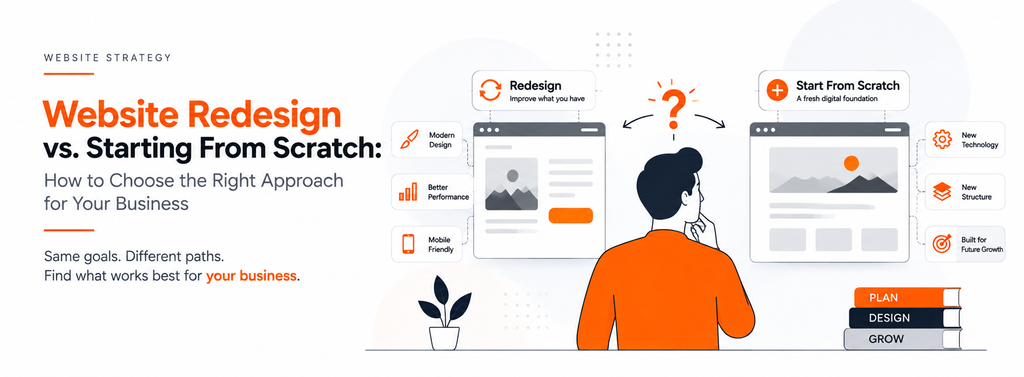
Should you redesign your existing website, or should you start completely from scratch?
The answer isn’t always about how old your website is. A website redesign can be the right choice when your existing foundation is still useful. On the other hand, starting from scratch may make more sense when your current website has technical limitations, poor structure, or no longer represents your business.
In this guide, we’ll explain the difference between website redesign and new website development, the advantages and disadvantages of each approach, and how to decide what’s best for your business.
What Is a Website Redesign?
A website redesign means improving or rebuilding an existing website while retaining some of its existing structure, content, technology, SEO value, or other digital assets.
Depending on your requirements, a redesign can involve:
- Updating the website’s visual design
- Improving navigation and user experience
- Making the website mobile responsive
- Improving page speed
- Updating website content
- Optimising pages for SEO
- Improving calls-to-action
- Redesigning landing pages
- Updating branding and visuals
- Fixing technical issues
- Improving conversion rates
A redesign doesn’t necessarily mean changing everything.
The goal is to identify what’s working, understand what’s not, and improve the website strategically.
What Does Starting a Website From Scratch Mean?
Starting from scratch means creating a new website rather than significantly modifying the existing one.
This approach may involve:
- New website architecture
- New UI/UX design
- New development
- New content structure
- New technology or CMS
- New navigation
- New integrations
- New SEO implementation
- New conversion strategy
For example, a business that has been using an outdated website for several years may decide to move to WordPress or Shopify, depending on its requirements.
Starting from scratch gives you greater freedom, but it also requires more planning, development, and investment.
Website Redesign vs. Starting From Scratch: The Key Difference
The simplest way to understand the difference is:
Website redesign means improving and rebuilding what you already have.
Starting from scratch means creating a completely new digital foundation.
However, the decision should be based on more than the appearance of your website.
You need to evaluate your current website’s:
- Technical health
- SEO performance
- Content quality
- User experience
- Website speed
- Conversion performance
- CMS or platform
- Security
- Scalability
- Business goals
When Should You Choose a Website Redesign?
A redesign can be the better option when your existing website has a solid foundation but needs improvement.
1. Your Website Looks Outdated
Design trends and user expectations change quickly.
If your website still looks like it was designed several years ago, visitors may perceive your business as outdated—even if your products or services are excellent.
A modern website should have:
- Clean visual hierarchy
- Consistent branding
- Easy navigation
- Mobile-friendly layouts
- Clear calls-to-action
- Strong typography
- Professional imagery
A redesign can modernise your website without throwing away everything you’ve already built.
2. Your Website Gets Traffic but Doesn’t Generate Leads
This is one of the biggest reasons businesses consider a website redesign.
You may already have visitors coming through Google, social media, referrals, or advertising.
But if visitors aren’t contacting you, requesting quotes, purchasing products, or booking services, the problem may be your website experience.
A redesign can focus on conversion rate optimisation (CRO) by improving:
- CTA placement
- Landing pages
- Contact forms
- Product and service presentation
- Navigation
- Trust signals
- Website copy
The objective isn’t simply to make your website prettier.
It’s to make your website work harder for your business.
3. Your Website Isn’t Mobile-Friendly
Today, users frequently browse websites using smartphones.
If your website requires visitors to zoom, scroll horizontally, or struggle with small buttons, you’re creating unnecessary friction.
A redesign can introduce a mobile-first approach, ensuring that your website works smoothly across smartphones, tablets, laptops, and desktops.
4. Your Website Already Has SEO Value
This is an important consideration when deciding between a redesign and a complete rebuild.
If your existing website already ranks for valuable keywords and receives organic traffic, completely replacing it without an SEO migration strategy can create unnecessary risks.
Your existing website may have:
- Indexed pages
- Ranking keywords
- Backlinks
- Organic traffic
- Valuable content
- Search visibility
A carefully planned redesign can preserve these assets while improving the website.
This is why SEO should be considered before—not after—a website redesign.
When Should You Start From Scratch?
Sometimes a redesign isn’t enough.
A completely new website may be the better choice when the existing foundation is holding your business back.
1. Your Technology Is Outdated
If your website runs on outdated technology, unsupported plugins, or an inflexible CMS, continuously fixing individual problems may become inefficient.
In such situations, rebuilding the website on a more suitable platform can provide a stronger and more secure foundation.
2. Your Website Has Serious Performance Problems
If your website consistently suffers from:
- Slow loading times
- Broken functionality
- Plugin conflicts
- Security issues
- Poor mobile performance
- Technical errors
then simply changing the design may not solve the underlying problems.
A new website architecture may be a more practical solution.
3. Your Business Has Completely Changed
Imagine a company that started as a small local service provider but now operates across multiple cities.
Its original website may not have been designed for:
- Multiple locations
- New service categories
- Larger content volumes
- E-commerce
- Advanced lead generation
- Complex integrations
If the business model has changed significantly, starting from scratch can provide the flexibility needed for the next stage of growth.
4. Your Website Is Difficult to Manage
Your website should make your team’s job easier.
If adding a new service, changing a product, publishing a blog, or updating images requires technical assistance every time, your current CMS may no longer be suitable.
A new website can be designed around how your team actually works.
Website Redesign vs. New Website: Comparison
| Factor | Website Redesign | Starting From Scratch |
|---|---|---|
| Existing website | Retained partially | Replaced |
| Design | Updated | Completely new |
| Development | Existing foundation may be used | New development |
| SEO | Existing SEO can potentially be preserved | Requires full SEO planning |
| Cost | Usually lower | Usually higher |
| Timeline | Generally shorter | Generally longer |
| Flexibility | Moderate to high | Very high |
| Technical limitations | Some may remain | Can be rebuilt |
| Content | Existing content can be improved | Can be rewritten/restructured |
| Best for | Websites that need improvement | Websites with major structural problems |
How Much Does a Website Redesign Cost?
There is no single website redesign cost because every project is different.
The cost can depend on:
- Number of pages
- Website platform
- Design complexity
- UI/UX requirements
- E-commerce functionality
- Custom development
- Integrations
- SEO requirements
- Content creation
- Migration requirements
- Performance optimisation
A small business website may require a relatively straightforward redesign, while a large e-commerce website may involve extensive UX, development, content, and SEO work.
Instead of choosing an approach based only on price, consider the long-term value of your website.
A cheap website that doesn’t generate enquiries can ultimately cost more than a strategically designed website that supports business growth.
Will a Website Redesign Affect SEO?
Yes—if it isn’t planned properly.
A redesign can improve SEO, but it can also cause ranking and traffic problems if important elements are accidentally removed or changed.
Before launching a redesigned website, businesses should review the following:
URLs
Avoid changing URLs unnecessarily. If URLs need to change, appropriate 301 redirects should be implemented.
Metadata
Review and optimise page titles and meta descriptions.
Content
Don’t remove high-performing content without understanding its SEO value.
Internal Links
Make sure important pages remain connected through a logical internal linking structure.
XML Sitemap
Ensure the new website has an accurate and updated XML sitemap.
Mobile Experience
The redesigned website should provide a strong and consistent mobile experience.
Page Speed
Optimise images, scripts, code, and other resources that affect website performance.
Analytics and Search Console
Make sure analytics tracking and Google Search Console monitoring remain properly configured after the redesign.
This is why combining website development and SEO strategy can be valuable during a redesign.
7 Questions to Ask Before Deciding
Before choosing between redesigning and rebuilding, ask yourself:
1. Is the current website generating traffic?
If yes, understand where that traffic comes from and which pages perform best.
2. Does the current website generate leads or sales?
If traffic exists but conversions are low, a redesign focused on UX and conversion optimisation may help.
3. Is the technology still reliable?
If the platform creates constant technical problems, rebuilding may be a better option.
4. Is the website mobile-friendly?
If not, improving responsive design should be a priority.
5. Has your business changed significantly?
If your services, target audience, or business model have changed, your website architecture may need to change too.
6. How strong is your current SEO?
Understand your rankings, organic traffic, backlinks, and high-performing pages before making major structural changes.
7. Will the website need to scale?
Think beyond today’s requirements.
Your website should support where your business is going—not only where it is today.
Don’t Redesign Your Website Just for a New Look
One of the biggest mistakes businesses make is treating a website redesign as a purely visual project.
A website isn’t successful simply because it looks attractive.
It should help your business:
Attract → Engage → Build Trust → Convert → Grow
That’s why a successful redesign should consider strategy, UI/UX, content, SEO, performance, and conversion together.
Your homepage, service pages, product pages, landing pages, navigation, forms, and CTAs should all have a purpose.
The Right Website Approach Depends on Your Business
There is no universal answer to whether you should redesign your website or start from scratch.
Choose a website redesign when your existing website has valuable content, SEO equity, traffic, and a workable technical foundation—but needs better design, UX, performance, or conversion.
Consider starting from scratch when your website has major technical limitations, an unsuitable platform, serious performance problems, poor architecture, or no longer supports your business model.
The most important step is to audit your existing website before making the decision.
Build a Website That Works for Your Business
At BlackBuck Design Studios, we believe a website should be more than an online brochure. It should communicate your brand clearly, provide a smooth digital experience, and support your business goals.
Whether you need a website redesign, website development, WordPress website, Shopify website, UI/UX improvement, or SEO-friendly digital experience, the right approach starts with understanding your business first.
Not sure whether your website needs a redesign or a complete rebuild?
Talk to BlackBuck Design Studios and evaluate your current website before making the investment.
Your next website shouldn’t just look better. It should work better.
